A columnist’s perspective on adaptation and humor with MS
Written by |

Ben Hofmeister sits in front of a piano; he enjoys watching his children play the instrument. (Photos by Michala Hofmeister)
In recognition of Multiple Sclerosis Awareness Month in March, the MS Awareness Month campaign features a series of stories highlighting the real-life experiences of people affected by MS, written in their own words. Follow us on Facebook, Instagram, X, and Pinterest for more stories like this, using the hashtag #MSAwarenessMonth, or read the full series.
Multiple Sclerosis News Today columnist Desiree Lama recently chatted with fellow columnist Ben Hofmeister about his multiple sclerosis (MS) journey. Excerpts of their conversation follow.
DL: You’ve been very open about how MS reshaped your day-to-day life. What was one of the hardest adjustments you didn’t expect when you were diagnosed?
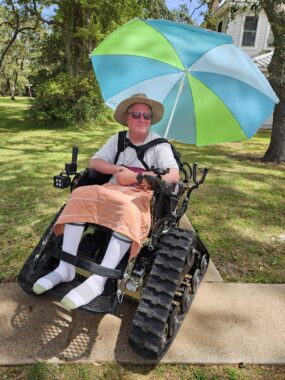
Hofmeister shades himself at the beach while using an Action Trackchair to navigate the terrain.
BH: Before MS, it always seemed like I had so much to keep me busy. I liked always being on the move and always having multiple things that needed my attention. When I was diagnosed, and as my symptoms progressed, I had to learn not to be busy, or actually to be busy in different ways. That transition between busy and MS was a lot harder than I ever thought it would be.
You often write about MS not defining who you are, but still deeply affecting how you move through the world. How do you hold both of those truths at the same time?
Not very well sometimes. At the start, I think I confused not being defined by MS with trying to pretend I didn’t have it, or that it didn’t affect me. I still have trouble wrapping my head around it, because it sounds like such a contradiction when I say it, but while I have accepted that MS is a part of my definition, it does not define me. Whatever I am, I still am. MS is an addition to my definition, but it is not the definition.
Fatigue and mobility changes can quietly dictate how a day unfolds. How do you decide when to push through and when to listen to your body?
It’s like you’ve been talking to my family! That is one of the biggest things I need to work on. Not listening to my body is what landed me in the hospital twice in recent years. As much as I would like to say that I’ve mastered knowing my limitations, even when they seem to change by the hour some days, there are times when I try to push through something I shouldn’t.
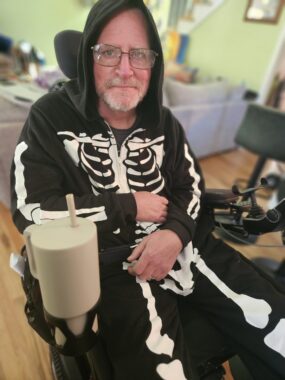
Hofmeister’s dry sense of humor shines through in his Halloween costume choices.
In general, I know when overextending myself is worth it or not, and I really think I’ve improved at that. What I still struggle with is the nagging feeling that if I don’t do something, someone will be disappointed or think I’m unreliable. It pains me to admit that it really boils down to pride and ego, and is something I should work on.
Your background includes a strong sense of discipline and structure. How has MS challenged or changed your relationship with control and planning?
That is actually very similar to my answer to the first question. I still do things with control and planning, it’s just adapted control and planning now, and the biggest difference is that it can’t be rigid. That’s one of the very few ways that MS has made me more flexible. With that said, I’m still not flexible enough, but I see the need, and I’m getting better at it.
You bring a lot of honesty and sometimes dry humor into conversations about MS. How important has humor been for you in coping and connecting with others?
During the first few years after my diagnosis, I made the mistake of thinking that laughing at the admittedly funny moments of a life with MS meant that I wasn’t taking it seriously. Finding tears in this life is easy. Laughing at the moments that deserve to be laughed at is much harder, but so important. Letting friends and family know that it’s OK to laugh sometimes, too, is equally important.
I have to be accommodated, but I don’t want to be treated any differently than I was before MS. That includes laughter. I don’t think I always noticed it before, but I sure missed it when it was gone, before I learned to laugh again.