When the answers to my health issues don’t involve MS
Written by |

Shara Sand is feeling much better after having heart surgery to address hypertrophic obstructive cardiomyopathy. (Photos courtesy of Shara Sand)
In recognition of Multiple Sclerosis Awareness Month in March, the MS Awareness Month campaign features a series of stories highlighting the real-life experiences of people affected by MS, written in their own words. Follow us on Facebook, Instagram, X, and Pinterest for more stories like this, using the hashtag #MSAwarenessMonth, or read the full series.
On Sept. 7, 2025, I suffered a near-fatal heart attack. My blood pressure (BP) dropped precipitously, and I was fortunate to receive immediate help, arriving at the hospital in cardiogenic shock, barely conscious, with a BP of 60/40. Hours later, I awoke to find myself connected to a 24-hour heart monitor, undergoing frequent BP checks every 15 minutes, and blood work every four hours. Two days later, an MRI revealed I had hypertrophic cardiomyopathy (HCM), a genetic disorder. Over and over, I heard how incredibly lucky I was to have survived such a “perfect storm.”
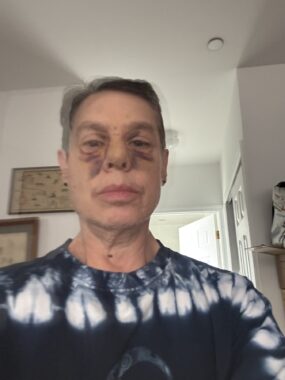
Sand shows her significantly injured face six days after suffering a major fall.
Further testing uncovered that I had a subvariant of HCM: hypertrophic obstructive cardiomyopathy (HOCM). Known as the “silent killer,” HOCM is often responsible for the sudden deaths of young athletes on the field. It involves a thickening of the left ventricular wall, causing turbulent blood flow, mitral regurgitation, and cavity obliteration — my own perfect storm.
These terms landed heavily. Upon discharge, I was instructed to stay hydrated, avoid exertion, refrain from exercise or heavy lifting, and only take brief, slow walks. I’d always prided myself on staying active with multiple sclerosis (MS), but now I had to accept that pushing myself could be fatal.
Expecting a discussion about medication, I met with an HOCM specialist. The doctor greeted me with a warm, friendly smile and a practical, pleasant manner. Given my dramatic presentation, she explained, “The only way to ensure this doesn’t happen again is to have open-heart surgery.” Incredulous, I responded, “Cracking my chest open with a sledgehammer is the only solution?” She nodded solemnly, reassuring me that the surgeon had 20 years of experience as she handed me his card. I left, stunned yet strangely grateful — at least this was something that could be fixed, unlike my MS.
Famous last words.
The surgery was a success, and my recovery progressed smoothly — I felt better than I had in years. But just two months and two days after the operation, while walking my dog, I was suddenly overcome with dizziness and the split-second thought, “I’m going to faint,” before collapsing.
When I regained consciousness, I found myself face down on the sidewalk, soon back in the hospital for more tests and monitoring. The sudden onset of symptoms and rapid loss of consciousness were diagnostic. Most people have time to break their fall; I did not.
Amazingly, I suffered no fractures and was once again told how lucky I was to have regained consciousness. I felt blindsided. I knew arrhythmias were common after open-heart surgery, but I had been assured that losing consciousness shouldn’t happen again. Unfortunately, my arrhythmia was both dramatic and concerning; my heart rate swung wildly from 45 to 160. This time, the only solution offered was the implantation of a cardioverter-defibrillator in my left clavicle. How could I refuse? I didn’t want to wake up kissing the sidewalk again.
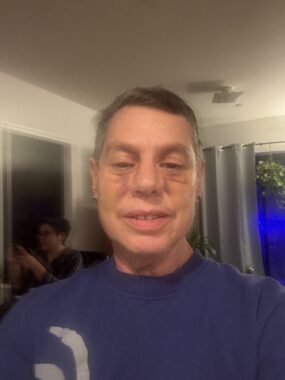
Ten days after her fall, Sand’s face is starting to heal.
After receiving the device, I felt better than I had in years. I hadn’t realized how compromised my function was with a heart operating at only 75% capacity. Previously, I walked as though my legs were made of lead. My shortness of breath, which I’d attributed to muscle exertion, vanished. Even the stubborn spasticity that persisted despite medication disappeared.
Before, I’d needed more sleep than ever before, waking exhausted after seven or eight hours. Now, five to six hours leave me feeling energized. The chronic congestion and wet cough I once blamed on allergies cleared up after the post-surgical nebulizer treatments.
Mostly, I feel calm, wrapped in an even temperament I thought I’d lost forever. What I once believed was a dysregulated mood from MS was actually tied to the dysfunction of my autonomic nervous system caused by my compromised heart. The surgery was like a system reset — rebooting my body much like restarting a computer.
Living with MS often leads me — and even my doctors — to attribute every symptom to the disease. Who can blame us? Its varied and consistently inconsistent nature invites misassumptions. I’m determined to be more vigilant when new symptoms arise.
My first question now will be, “If we take MS off the table, what else could this be?”