Privosegtor for multiple sclerosis
 Fact-checked by
 What is privosegtor for MS?
Privosegtor, previously known as OCS-05 and BN201, is an experimental small molecule being developed by Oculis to treat acute optic neuritis, a common symptom of multiple sclerosis (MS) that can lead to vision loss.
It is administered via intravenous, or into-the-vein, infusions, usually for a few days. Clinical data have shown that it can improve measures of vision and eye health when given alongside standard steroids.
Optic neuritis is a condition marked by inflammation of the optic nerves, which transmit information from the eyes to the brain. It is a common manifestation in autoimmune diseases, and among the first symptoms in about 20% of people with MS.
While optic neuritis typically resolves on its own or with anti-inflammatory corticosteroid treatment, some individuals may experience permanent vision loss. Privosegtor is designed to protect the optic nerve from further damage, which is expected to prevent more severe vision impairments.
Studies in animals also suggest it can promote the repair of myelin, the protective coating around nerve cells that is damaged in MS and other demyelinating conditions. Damage to myelin is the primary driver of optic neuritis in these conditions, and repairing it can potentially reverse some of the damage to the optic nerve.
Following positive Phase 2 data, Oculis has announced plans to start two pivotal Phase 3 studies that will evaluate privosegtor for acute optic neuritis in people with and without MS. If positive, data could support regulatory applications requesting the approval of privosegtor for optic neuritis.
Oculis is also investigating privosegtor as a treatment for another nerve-related vision disorder called nonarteritic anterior ischemic optic neuropathy.
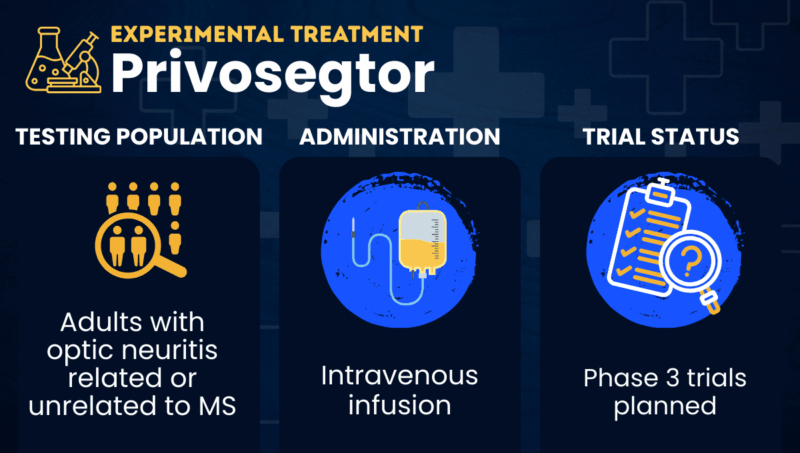
| Treatment name | Privosegtor |
| Administration | Intravenous infusion |
| Clinical testing | A Phase 2 trial is complete, and Phase 3 trials are being planned |
How will privosegtor be administered in MS?
Privosegtor is administered via an intravenous infusion. In a Phase 2 clinical trial, it was given daily for five consecutive days, alongside intravenous steroids, at a dose of 2 or 3 mg/kg.
The upcoming Phase 3 trials will assess the medication at a dose of 3 mg/kg.
Privosegtor in clinical trials
Privosegtor was first tested as a treatment for optic neuritis in the ACUITY Phase 2 clinical trial (NCT04762017), which enrolled 33 people with acute optic neuritis in one eye, primarily due to MS. Participants were randomly assigned to one of two doses of privosegtor or a placebo. Treatment was started within 12 days of the onset of vision problems. Results showed:
- Privosegtor was safe and well tolerated, with no serious side effects reported.
- Two different layers of the retina that become thinner with nerve damage were 30%-43% thicker in the high-dose group after six months, compared with the group that received steroids only.
- Vision function, measured with a test that evaluates how well patients can read faint gray letters on a white background, was significantly better in the high-dose group. After six months, these patients could read 15 more letters than those given a placebo.
- Patients given privosegtor showed consistently lower blood levels of neurofilament throughout the six months of follow-up, indicating less nerve cell damage.
Oculis is planning two Phase 3 trials that will follow a similar design to ACUITY. About 140-160 participants with optic neuritis, with or without MS, are expected to enroll. Patients will receive privosegtor or a placebo for five days, and will then be followed for six months. The main goal is to assess changes in visual function after three months.
Privosegtor side effects
The ACUITY trial reported no serious adverse events, and no side effects caused participants to stop treatment. The most common side effects were:
- acne
- headache.
Multiple Sclerosis News Today is strictly a news and information website about the disease. It does not provide medical advice, diagnosis, or treatment. This content is not intended to be a substitute for professional medical advice, diagnosis, or treatment. Always seek the advice of your physician or other qualified health provider with any questions you may have regarding a medical condition. Never disregard professional medical advice or delay in seeking it because of something you have read on this website.