New CSF protein markers may help support multiple sclerosis diagnosis
Protein panel in spinal fluid may help identify difficult-to-diagnose MS
Written by |
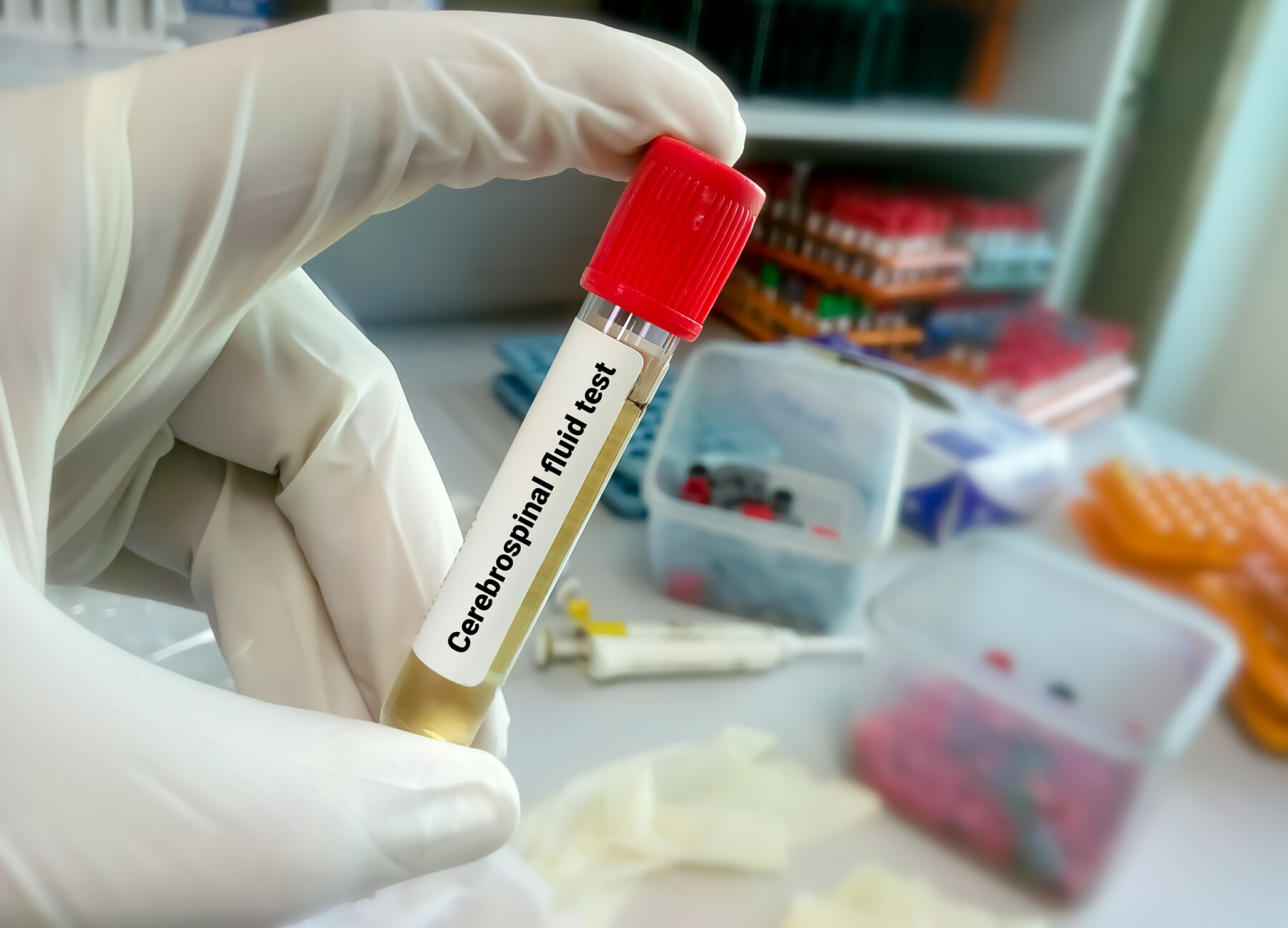
A scientist holds a tube containing cerebrospinal fluid. (Photo from iStock)
- New cerebrospinal fluid (CSF) protein markers may help support the diagnosis of multiple sclerosis.
- The markers may be particularly useful for patients who lack oligoclonal bands, a common MS diagnostic marker.
- Certain CSF protein patterns were also linked to future disability progression and different forms of MS.
A test that measures a specific set of proteins in cerebrospinal fluid (CSF) — the liquid that surrounds the brain and spinal cord — may help support the diagnosis of multiple sclerosis (MS), a new study shows.
The approach could be particularly useful for people who lack a common CSF diagnostic marker known as oligoclonal bands.
The findings were described in the study, “Large-scale proteomics across neurological disorders uncovers biomarker panel and targets in multiple sclerosis,” published in Cell.

Why some MS cases are harder to diagnose
In MS, one of the key laboratory findings used to support diagnosis is the presence of oligoclonal bands, which indicate that antibodies are present in the CSF. These bands are considered a hallmark of the disease and are included in current diagnostic criteria for MS. However, about 10% of people with MS do not have oligoclonal bands, which can make the disease harder to diagnose and sometimes delay treatment.
“In approximately ten percent of MS patients, diagnosis of the disease is particularly difficult because they lack the typical MS marker of so-called oligoclonal bands of antibodies that are specific to the CSF and not found in the blood. This complicates and potentially delays the diagnosis,” said Christiane Gasperi, MD, a study co-author at the Technical University of Munich in Germany, in a university news story.
To address this gap, a team led by researchers at the Technical University of Munich and the Max Planck Institute of Biochemistry used large-scale proteomics, a technique that enables scientists to measure thousands of proteins at once, to analyze CSF samples from people with neurological diseases.
The team developed a workflow capable of examining thousands of proteins in each sample and applied it to CSF samples from more than 5,000 people, including individuals with MS and a wide range of other neurological disorders, such as inflammatory and neurodegenerative conditions that can resemble MS.
“Proteomics is a scientific discipline that aims to characterize a biological system by measuring all proteins, or at least as many as possible,” said Jakob Bader, PhD, a study co-author at the Max Planck Institute of Biochemistry. “For our study, it is essential to cover as many proteins as possible in order to increase the likelihood of measuring and later finding real disease markers.”
Protein signatures in spinal fluid may help identify MS
By comparing protein signatures across diseases, the researchers identified patterns associated with MS. They ultimately defined a panel of 22 CSF proteins that improved the ability to distinguish MS from other neurological disorders, particularly in people without oligoclonal bands.
“It is particularly encouraging that we have found a combination of marker proteins that help in the diagnosis of this particularly difficult-to-identify form of MS,” Gasperi said.
Beyond diagnosis, the researchers also examined whether measuring CSF proteins might be linked to long-term outcomes. Their analyses showed that certain protein signatures were associated with future disability progression and could distinguish between different forms of MS.
“Our findings suggest that important aspects of future disability and disease course are reflected in the proteome from the very beginning. This demonstrates that the biological information required for a prognostic test is already present at diagnosis,” said Bernhard Hemmer, MD, a study co-author at the Technical University of Munich.
The team suggested that these protein panels could serve as a basis for developing tools to help support diagnosis and better understand disease course. However, larger studies will be needed to confirm clinical usefulness and determine how advanced CSF analyses could be integrated into existing diagnostic frameworks.
“Validating clinical benefit will require large, well-characterized cohorts, ideally through prospective, multi-center studies. Such studies will also need to identify how to best integrate advanced CSF biomarkers with MRI findings,” the scientists wrote.