
Pilates improves mobility and balance, fatigue in MS: Review study
Quality of life benefits also observed; further research needed
Written by |
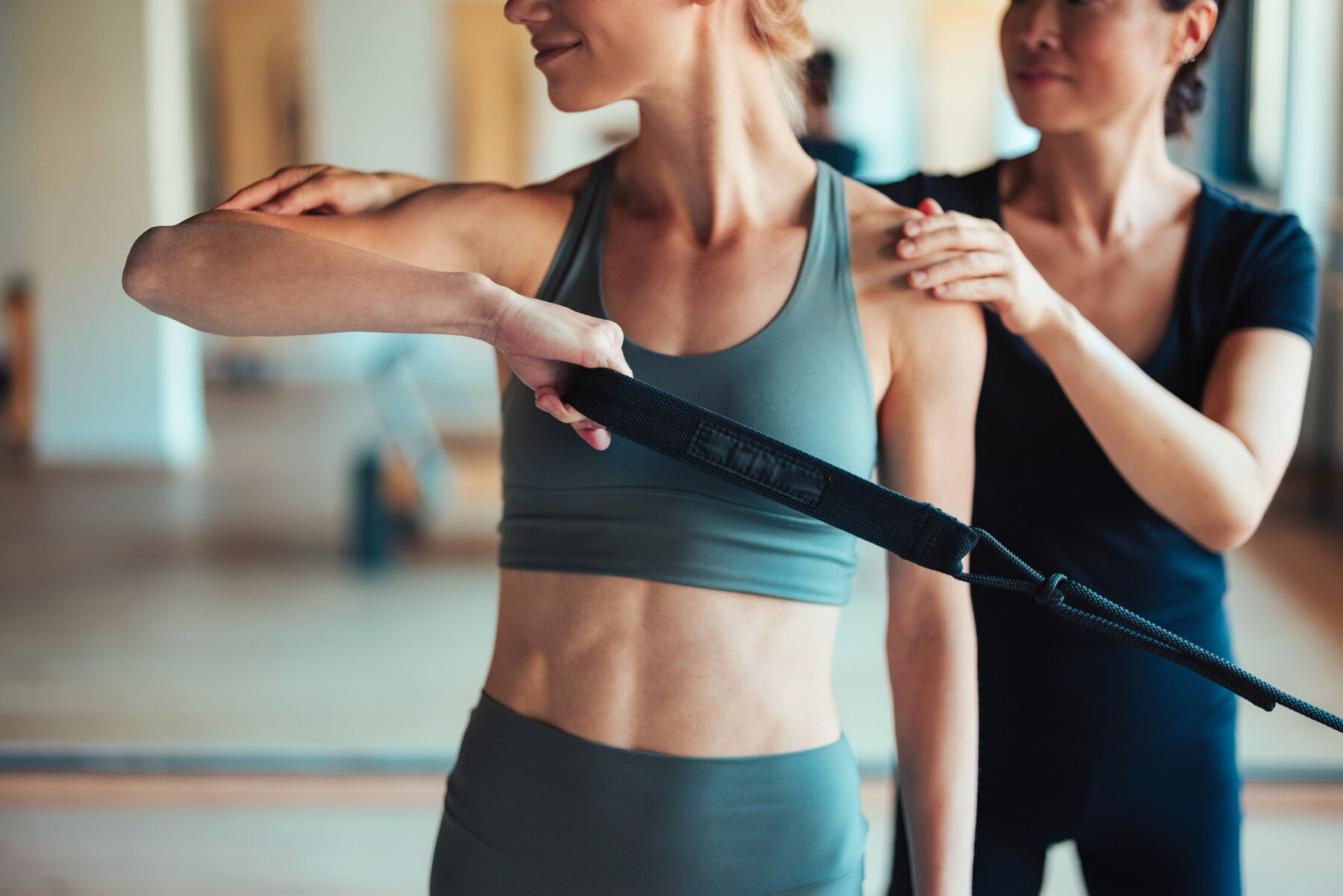
A fitness instructor provides individualized guidance to a woman performing strength exercises with a resistance band.
- Pilates may improve mobility, balance, and quality of life for people with multiple sclerosis.
- It can also help reduce fatigue in individuals with MS.
- Supervised, tailored Pilates training by physiotherapists is promising, but more research is needed.
Note: This story was updated July 16, 2026, to correct that home-based Pilates led to a 9.5-point benefit in the Modified Fatigue Impact Scale, not 99.5 points.
Pilates-based interventions may improve mobility, balance, and quality of life of people with multiple sclerosis (MS), while reducing their fatigue, according to a review study.
According to the researchers, supervised Pilates may be helpful alongside rehabilitation when delivered by trained physiotherapists and tailored to patients’ disability level, fatigue level, and functional goals.
However, its “routine implementation should await adequately powered trials with standardized protocols, consistent outcome measures, and longer follow-up to confirm clinically meaningful and durable benefits,” they wrote.
The study, “Comparative effects of pilates-based interventions on functional mobility, balance, fatigue, and quality of life in people with multiple sclerosis: a systematic review and network meta-analysis,” was published in BMC Sports Science, Medicine and Rehabilitation.

Pilates combines precise movements, breathing exercises
MS is driven by immune-mediated damage to the brain and spinal cord, specifically targeting the myelin sheath, a protective coating around nerve fibers that helps nerve cells communicate efficiently. Walking and balance difficulties, as well as issues with posture and fatigue, limit MS patients’ independence and quality of life.
Stretching and flexibility exercises, including Pilates, may improve mobility and reduce muscle stiffness in people with MS. Pilates is a mind-body form of exercise combining precise movements and breathing techniques to strengthen muscles and improve posture, flexibility, and awareness. Yet, the effectiveness of different Pilates modalities in managing MS symptoms remains uncertain.
To learn more, researchers conducted a systematic review and a meta-analysis (which pools data from multiple studies) of the effects of Pilates-based interventions on mobility, balance, fatigue, and health-related quality of life in adults with MS. The analysis included 22 clinical trials conducted in six countries — Turkey, Iran, Ireland, Canada, the U.K., and Israel — which collectively enrolled 901 MS patients.
Most studies mainly included women. The participants’ mean age ranged from 30 to 55 years. When such information was specified, the most common disease type was relapsing-remitting MS.
In all studies, patients were randomly assigned to a Pilates intervention or a control group for at least four weeks. Control groups included usual care and no intervention or other non-Pilates programs.

Pilates resulted in greatest improvements in walking distance
Results showed benefits in the Timed Up and Go (TUG) test — a functional test that measures how quickly people stand up from a chair, walk a short distance, turn, and sit back down — with Pilates reducing the time to complete the task by 5.23 seconds. Pilates and Pilates Training were the only strategies associated with meaningful TUG improvement, in contrast with interventions such as clinical pilates and mat pilates.
Pilates also led to the largest significant gain compared with the control intervention, as shown by an 8.58-point increase on the Berg Balance Scale.
Combined with Pilates-based telerehabilitation, Pilates resulted in the greatest improvements in walking distance, as shown by a mean increase of 50.81 meters (166.7 feet) in the six-minute walk test. The same combination was the only strategy that significantly reduced fatigue, by 2.46 points, on the Fatigue Severity Scale. Home-based Pilates led to the largest benefit (9.5 points) in the Modified Fatigue Impact Scale.
Pilates-based telerehabilitation further yielded significant effects in improving physical and mental health-related quality of life, based on an MS quality of life scale.
Overall, this study shows that “Pilates-based interventions may offer benefits across functional mobility, balance, walking endurance, fatigue, and health-related quality of life in people with MS,” the researchers wrote.
However, the general certainty of the evidence is low, and differences in whether specific strategies are more effective than others “should be treated as exploratory,” the researchers wrote. Also, they noted that most studies included participants with mild to moderate disability, which means that the results may not be extrapolated to those with advanced MS, and that protocols varied widely regarding Pilates’ intensity, duration, frequency, or supervision.
“Future research should include adequately powered randomized trials with standardized Pilates protocols, clear reporting of dosage, supervision, and adherence, and longer follow-up to assess sustainability of effects on fatigue, balance, and quality of life,” the scientists concluded. “Studies should also examine optimal integration with Pilates-based telerehabilitation, cost-effectiveness, and comparative efficacy across disability levels.”




Leave a comment
Fill in the required fields to post. Your email address will not be published.