What literary criticism taught me about living with MS
Written by |
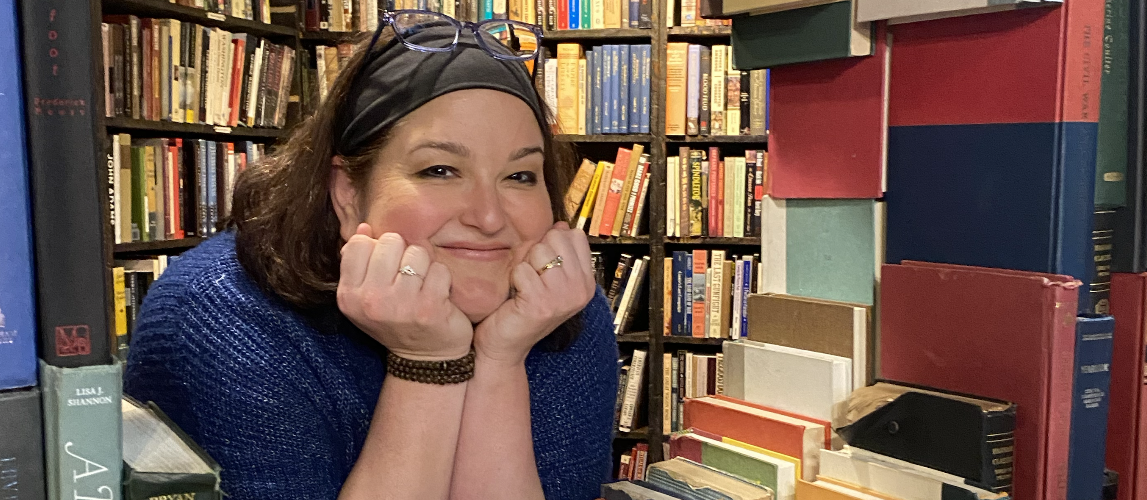
Jamie Hughes loves to draw new insights, knowledge, and inspiration from books. (Photos courtesy of Jamie Hughes)
In recognition of Multiple Sclerosis Awareness Month in March, the MS Awareness Month campaign features a series of stories highlighting the real-life experiences of people affected by MS, written in their own words. Follow us on Facebook, Instagram, X, and Pinterest for more stories like this, using the hashtag #MSAwarenessMonth, or read the full series.
When I was a young’un in college pursuing two bachelor’s degrees — one in secondary education and one in English — I took a lot of classes (and I mean a lot) that required me to apply something known as literary criticism.
Rather than simply focusing on the nuts and bolts of writing or offering a subjective opinion (“I liked this story” or “I hated it”), it requires students to analyze, interpret, compare, and evaluate novels, plays, and poems through specific lenses.
For example, take F. Scott Fitzgerald’s masterpiece “The Great Gatsby,” which was written and set in and around New York City in the 1920s. Jay Gatsby, an überwealthy man, throws lavish parties in the hope that his old girlfriend might show up. She does. The problem? She’s married. Her husband is having an affair. Gatsby and Daisy start an affair of their own, and it all pretty much goes downhill from there.

Jamie Hughes grabs her copy of “The Great Gatsby” to help explain that there are many ways of viewing life with MS.
If I were looking at this story through the lens of formalism, I’d focus on the symbolism of the green light blinking on Daisy’s dock across the lake or the giant billboard eyes of Dr. T.J. Eckleburg looking over the Valley of Ashes.
If I wanted to analyze it from a Marxist perspective, I’d focus on the idea that “old money” (represented by Daisy and Tom) gets away with literal murder while “new money” (Gatsby) takes the fall for it — propping up the established economic system.
If I wanted to tackle it from a biographical perspective, I’d see the story as Fitzgerald processing his complicated marriage to his wife, Zelda, and the wildness of the Jazz Age.
You get the idea. The story doesn’t change, but how you read it does.
Having to revisit works of literature and analyze them from different perspectives can be challenging, but I found that I enjoyed it because doing so kept my mind flexible. No one reading of a work was the “right” one, and each approach taught me something new about the story and about myself.
When you’re diagnosed with multiple sclerosis (MS), everything changes. Your world is turned over, shaken like an Etch A Sketch, and slammed back down. And once you get past the shock, you have to create a new narrative for yourself. You must choose a “lens” through which to view your story.
Is it pure tragedy, a comedy of errors, a heroic journey, or a tale of transformation? Are you going to be a victim or a hero, one boldly carrying on despite the many challenges? How about your approach to life now that MS is a part of it? Are you going the Pollyanna route or something closer to Eeyore’s?
Like Fitzgerald’s novel, the story is the story. Millions of people have read it and come away with different perspectives, different ways of understanding what they experienced in its pages. And the same is true of us as people with MS. The disease is the disease; we can’t change it. But we can change how we view it and who we are now that it is an inescapable part of our lives. We can view our stories through whatever lens we choose.