In this episode of “Get Tough on Multiple Sclerosis,” Mirla Avila and Susan Payrovi, MDs, break down the stages of MS, what progression really looks like, and how to tell the difference between a relapse and true disease change. They tackle myths, explain smoldering MS and PIRA, and highlight the subtle signs that deserve attention — even when your MRI is quiet.
Episode 6 Show Notes
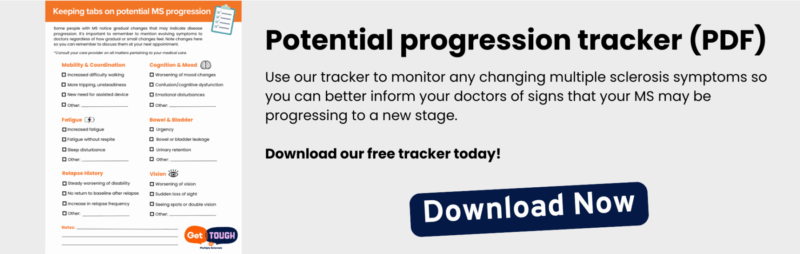
Our progression symptom checklist helps you to keep tabs on changes in your condition so you can remember to mention them at your doctor appointments. Because progression can be subtle and gradual, it’s important to mention any shifts, regardless of how insignificant they feel.
Contact the show
Have a question for our hosts? Contact us at [email protected] — we’d love to hear from you.
Join our mailing list
Don’t miss alerts on new episodes and stay informed with the Multiple Sclerosis News Today eNewsletter. Get the latest MS news, breakthrough research, expert insights, inspiring patient stories, and exclusive videos.
Transcript
Susan Payrovi, MD: Welcome back to episode number six of Get Tough on Multiple Sclerosis, brought to you by Multiple Sclerosis News Today and Bionews. I’m Susan. I’m a functional medicine doctor treating chronic illnesses including MS, and I’m also a person living with MS.
Mirla Avila, MD: I’m Mirla Avila I’m an MD neuroimmunologist, and my main focus in my clinic is MS and other neuroimmunological disorders. And I’m very happy to be here today with all of you.
Payrovi: Wonderful. So today we’re going to talk about how MS is classified because no two people look the same or present the same, even if they’re presenting with the same flavor of MS. And we’re also going to cover key signs that you might be progressing, such as going from relapsing-remitting MS to secondary progressive. And we’ll talk about how you can tell the difference and what you should do about it.
Avila: Important topic. And many patients, when they’re diagnosed, they ask, what are the differences? What type of MS do I have and why does that make a difference? So we’re going to be talking a little bit more in detail about this.
Payrovi: Well, let’s just jump right in. What are the different classes of MS?
Avila: So in the future, we may start hearing more and more that we are going to start classifying them in progressive MS and nonprogressive MS. But in general, we have different classes of MS. So we have one that’s called the clinically isolated syndrome. We have one that is the relapsing-remitting MS. The active secondary progressive MS, or progressive secondary progressive MS, active or not. And then the primary progressive MS, which can also be active or not.
Payrovi: And you know, I’m also hearing a lot about smoldering MS recently. Can we talk about that?
Avila: For sure. This is, um, a lot of research has indicated that sometimes you can have inflammation under the background that we call smoldering neuroinflammation. The word is just because smoldering means something that is burning very softly. So in the MS world, we can have an active lesion causing inflammation in the brain — you know, that will be an acute inflammation.
But once that lesion settles, sometimes it can be left with some, like, kind of like a slow-burning fire. And that’s what we call smoldering inflammation. And as we’re going to see, it can actually be a driver for disability later on. And there are different ways that we can actually identify that in MRIs and PET scans.
Um, why is that important? Because it can indicate when somebody has this chronic inflammation that basically is talking about active, progressive MS — either, um, active secondary progressive MS most of the time. But what is important to know is that sometimes those cells and those changes can start very early. They can even start in the early stages of MS. So it’s not always only seen in the active secondary progressive MS, but they are a leading cause for disability.
Payrovi: So can you tell us about, um, some of the key players that are, um, causing us to classify MS in one category versus another?
Avila: So when we’re talking about the different categories, we know that our immune system responds — you know, in the case of MS, likely Epstein-Barr — identifying Epstein-Barr as if it was myelin, as if it was covered by Epstein-Barr, triggers an immune response. When we have that acute immune response, it will be T cells, B cells that get targeted. Once these go in, destroy the blood-brain barrier causing that active inflammation. Eventually, that active inflammation subsides. And maybe because we use steroids on that active lesion or over time it may subside.
But there’s a number of patients in which that activation — basically, there was also activation of a part of the immune system that is inside the brain. So these are very important, specialized immune cells called the microglia. To me, they’re my favorite cells in the whole body. These are actually cells that you’re born with inside your brain already. And they are immune cells that are surveilling your brain.
Their main purpose is to be checking and making sure that there’s not something abnormal inside your brain. And once they get activated, they’re supposed to be deactivated later on. But for some reason, in some patients, those cells do not go to their resting point. So they continue to be active. So that is one of those activation of microglia — smoldering neuroinflammation — that can lead to eventually progression in the disease. Even if your MRI scans look normal — not normal, but don’t show enhancing lesions anymore — that doesn’t mean that there may not be inflammation under the surface.
So when we’re talking about the different types of MS, and I just would like to elaborate a little bit. So clinically isolated syndrome will be — I’m going to give an example. A young patient comes in with an optic neuritis, meaning that they have pain in one eye with loss of vision in one eye. We do an MRI, and we don’t see a full criteria. We call the McDonald criteria — that MRI criteria based and also the clinical criteria that helps us diagnose MS. So that patient does not fully fulfill that. But they are presenting with likely the first symptom of MS. So many treatment options are aimed to — you can use those treatment options to prevent that fully blown MS.
The most typical MS that we have is relapsing-remitting MS, and about 80 or 85% of the patients will have this type of MS. And in relapsing-remitting, you will present with these events, these relapses that last more than 24 hours. And then it may take weeks to sometimes days to weeks to even months to get better.
You may go back to your baseline, but many times you don’t go back to your baseline depending on how aggressive that relapse was. And we have a bunch of treatment options for this type of MS. So 21 options and counting — all the treatment options that we have actually can treat relapsing forms of MS.
What happens if we don’t treat it? Then a number of patients can end up having secondary progressive MS. Secondary progressive MS would be after years of having relapsing-remitting MS. Then you start accumulating disability and slowly noticing that things are getting worse.
It may be your walking. It may be your memory. It may be, um, your dexterity depending on where the lesion load is. And then these symptoms just start adding up and up and up, and we don’t have those clear relapses like we used to. But we do have slow progression of the disease. Many of these patients, if we were to do a PET scan or a special type of MRI, we can look at that microglia activation and realize that old cells are actually enlarging. So we call these enlarging T2 cells. And that is likely because of that underlying microglia activation.
And then we have the primary progressive MS, which is very different — more common in male patients. Um, most patients have more spinal cord lesions. And these patients will start having accumulation of disability from the beginning of the diagnosis without these clear relapses.
Now, to make it a little bit more confusing, you can have active secondary progressive or active progressive MS. And that means that you may have activity — either clinical activity that is getting worse over time, like your walking or your memory, or MRI changes like these enlarging T2 lesions. And why is that important? Um, we don’t have a treatment option right now to target that in particular, but that is under development. So maybe in the near future we are going to have medications that are going to be targeting that microglia and that chronic inflammation.
Payrovi: Yeah. And something I always like to say is, you know, if the immune system is kind of going awry and gone a little rogue, you know, we’ve got to figure out — we can’t always figure out — what the danger signal is that the immune system is perceiving and the cells are reacting.
But there are some things that are modifiable that we can put into place to reduce the load on the immune system, reduce the load on the nervous system, in hopes of improving things. And that always, for me, goes back to lifestyle. If we can sleep a little more, eat more nutritious food, exercise our bodies, manage stress better — those may help change the signals that are being received by the immune system, and maybe things can get dampened down. So I think that’s always worth doing.
But before we get deeper into our main topic here, shall we jump into a round of myth or fact, Doctor Mirla?
Avila: Sure, yeah.
Payrovi: Okay. All right. So here’s the first question. Um, if I am diagnosed with relapsing-remitting multiple sclerosis, I will eventually transition to secondary progressive MS. Is that myth or fact?
Avila: That is a myth. Not every patient progresses. Um, I would like to add a little bit without being too elaborate on the natural history of the disease, because MS is a disorder, a disease that we have known about — about the disorder — for so long. So the first case of MS was actually in the 1400s, and it was a Catholic nun called Ludwina. And she was an avid ice skater. And she was 15 years old when she started having difficulty with balance. And in the literature, they describe very clear symptoms that got better, and then optic neuritis got better, and then eventually she developed secondary progressive MS.
I want to mention this because for centuries, we have known about the disease, but we didn’t have treatment options until the late or early 1990s. But now with the treatment options, that is not the case. I don’t want patients to feel that everybody that has relapsing-remitting is going to develop secondary progressive, or that a good number of patients are going to develop secondary progressive, because now with the highly efficacious medications we have, we’re seeing less and less of this. That is important — important to know because, as you were saying, there are many things that you can do as a patient to keep your immune system in balance. And as physicians, there are many things that we can do for our patients, too.
An example will be — if you have a newly diagnosed, it’s going to be very important to choose a proper medication, make sure it’s working, because if that one is not working, we have other treatment options. And also educate the patient — why is it so important to remain in your disease-modifying therapy to prevent precisely that progression that could occur?
Payrovi: I remember when I first got diagnosed with MS. My neurologist said something to me like, “If you were ever going to get MS, this is the time to do it.” Like, this is the most we’ve ever known about the disease. This is the most number of treatments we’ve had. And even though I was thrilled about that, I still didn’t really want the diagnosis. But I do think that we’re in a very different era, um, in the treatment of MS.
So let’s do another myth versus fact. How about this one? Having secondary progressive MS means I will be in a wheelchair.
Avila: Uh, no, not really.Because there are many forms of disability, not only gait. Um, obviously, if you have secondary progressive MS, you may be having some difficulty walking, but you may have secondary progressive MS and have more cognitive decline than walking difficulties. I would just rephrase this — disability. So if you have secondary progressive MS, that means that you will have a form of disability, then yes, that would go hand by hand, but not walking per se.
Payrovi: I’ve got another one for you. Um, your MRIs may not show active MS. Is that myth or fact?
Avila: That is actually important to know. And, um, I know this is a gray area because it depends on a lot of things. What type of MRI did you have? An open air, a 1.5, or a three-Tesla MRI? What sequences do you have in MRI? Were you doing something to look to see if there’s inflammation or enlarging T2 lesions?
So let’s say, um, if you had a perfect MRI done with a three-Tesla, looking at all the parameters that you need with the MS protocol, and that is stable, then yes — your disease is right now not progressing. And that’s great. But we can miss a lot if we’re using, like, an open-air MRI, for example, or we’re not using the proper settings like an MS protocol MRI. Um, so that’s the tricky part.
The other thing important to know is that the best objective way we have to measure what’s going on under the surface is with an MRI. So you may feel clinically okay, but if we are not doing MRIs, we may be missing that window of opportunity to escalate treatment because many, many times lesions can be silent. You may physically be feeling fine, but under the surface lesions may be popping out. So that’s why the MRI — I know it’s uncomfortable, nobody loves to be in the tube — but that’s the best objective measurement that we have until now.
Payrovi: So I’ve got another one for you. How about this: If I haven’t experienced a recent relapse, no changes in MRI activity, and no new major symptoms, my MS is stable. Is that true or is that a myth?
Avila: At that moment in time, it is true. And we call that NEDA. So NEDA means no evidence of disease activity. And that is the goal that we want to achieve as practitioners, because we don’t want patients having more relapses, we don’t want them having new lesions in the MRI, and we don’t want them having progression of their disability. And that is our main goal. We don’t have a cure yet. Hopefully one day we will have it. But we do have good therapies that we can achieve this NEDA. And I like to joke about it — you know, I’m Hispanic. I like to say it’s “nada,” which means nothing in Spanish, because that’s what we want. We don’t want any evidence of activity.
Payrovi: Can you have NEDA with smoldering MS simultaneously?
Avila: Um, in theory, no. If we’re looking at the good parameters — you know, if we’re doing the MRI and we’re seeing that lesions are not enlarging and we are achieving that NEDA, that means at that moment in time, we’re stable. Now, it doesn’t mean that, okay, we’re great, we can stop everything because we have reached a cure. That’s not the case. It’s — at this moment, we are stable, but we need to continue what we’re doing. We need to continue monitoring because that could change if the medication is not effective or if the patient stops the medication. So there are many reasons why that could change.
Payrovi: Okay. So you did a great job of breaking down the different classes of MS and how MS is classified. Can you talk to us a little bit about why it’s useful to have staging and classification? Like, why does that matter?
Avila: For us prescribers, it matters because there are medications that are approved for different forms of MS. So all the medications we have on the market are approved for relapsing-remitting MS, and most of them are approved for clinically isolated syndrome. But there is only one approved, for example, for primary progressive MS. And for active secondary progressive MS, we have many options to treat also. But maybe in the near future, we’re going to have — as I mentioned — one that is going to be, or a few that are going to be, targeting the microglia. That would be better if this patient is having that smoldering neuroinflammation.
So for us, it basically will help us target the treatment therapy which will be the best option. In a patient perspective, it may be different. And I know that nobody wants to hear that your MS may be progressing. But I think it’s important to define, realize it, and treat accordingly because even if it is progressing, it doesn’t mean that we don’t have treatment options to hopefully be able to hold or delay that progression. So it’s important to identify it and to move forward and treat it.
Payrovi: Yeah, I agree. I think when we hear that we have a certain class of MS, we can kind of get stuck in that thinking and worrying and being anxious about it. And I can acknowledge that it can be upsetting, even myself as a physician. Even though I have relapsing-remitting that’s been relatively stable, I still worry about even just being in that class.
And one thing I want to also say to anybody out there — that, you know, if you’re secondary progressive, primary progressive, and you feel like there’s less treatments out there for you — as a functional medicine, integrative medicine physician, I want to say there are always lifestyle medicine treatments that I think should be a part of MS care whether or not you are on DMTs and therapies or not, because it can only help. How much it can help, we don’t know. But is it worth trying?
Absolutely, because we want to start putting into place the things that are going to shift our environment and help us bring our body systems back into balance in hopes of sending a different signal to our immune system, making our immune system more robust, reducing stress, and sleeping — and all the things that, you know, we’re always talking about.
And we’ve actually spent quite a bit of time talking about these in other episodes. If people want to go back and check, I think that would be really great. So, you know, you mentioned progression. How do you, as a neurologist, identify whether or not somebody is progressing?
Avila: So there are many signs and symptoms. So the physical exam that we do helps us, and we compare it to our previous exam. For example, we may realize that somebody is weaker, that their gait may have changed. Maybe they come show up now using a cane when they were not using a cane, or, um, the foot drop may be worse, and this is causing them to fall.
Memory can be a little bit more tricky, because sometimes a patient may realize that their memory — um, you know, they’re having maybe word-finding difficulty or changes. But also asking the family member can be important, because a family member may have realized some changes that the patient hasn’t, just because you live with yourself every day. And if these changes are slow, you may not realize it or blame it on something else. Many patients say, oh, I just feel that I’m older — you know, I’m getting older. This is normal. So sometimes it’s difficult to differentiate what would be normal aging versus some progression in the MS.
And the, um, study — we can do different studies to look at the MRI lesions. For example, if we’re doing a three-Tesla, there are some studies — there’s something that we call SWI. It’s a susceptibility diffusion image that we can add to the MRI. It doesn’t add cost or time. It’s just something that the technician has to do when they’re doing the MRI. And this can help us look for something that we call paramagnetic rim lesions, meaning that microglia activation — talking about that smoldering neuroinflammation.
There are other things that we could do in the blood and in the spinal tap looking for some biomarkers that can also help us differentiate and look for activation. So there are some things in the clinical exam, in the questioning — patients and family members — and also some other studies that we can do in the lab or in the MRI.
Payrovi: Okay. So it’s a combination of symptoms that the patient or family reports. It’s also signs that you as a physician find on clinical exam. And it’s imaging. So it’s a combination of those three things that can help you if there’s progression. And so when should somebody notify their doctor if they’re noticing symptoms? How much time should they wait for the symptoms to be there? What kind of symptoms are more worrisome than others?
Avila: When in doubt, I always recommend call your doctor or your care provider and explain the symptoms, and they can help discern. So it’s not infrequent that I’ll have a patient call and say, I feel something is off, something is, um — you know, let’s say, for example, my fatigue is worse, and I’m having more pain and having more difficulty walking.
My first question is going to be, how long has this been going on? Is it intermittent or not? If it’s intermittent, it may not be a new lesion. If it’s constant for more than 24 hours, it could be a relapse or a pseudo-relapse.
My second question would be, is there any infection going on? How do you feel respiratory-wise, bladder-wise? Because sometimes, if you have a UTI, if you have a cold or respiratory infection, you may have what we call a pseudo-relapse. So this is worsening of MS symptoms without being a real MRI lesion. But when in doubt, we sometimes would do MRIs and give steroids, obviously, when there’s a relapse.
So, um, I don’t — I never feel bothered by patients reaching out if they have a question. Um, I think it’s important to have that communication with your provider and to be able to reach out and say, something is wrong and help me. Let’s try to decipher what it is.
Payrovi: Yeah. I think it’s just really important for patients not to feel like they have to decide whether it’s MS or not. Like, let the professionals do it. Call your doctor. They have teams that can help take, you know, take your question and get it to the right person. Um, it’s actually what they do. So don’t be shy about doing that.
Okay. Doctor Avila, thank you for all of this wonderful information that clarified the different stages of MS, why it matters to do staging and classifying, and how to pick up, um, possible progression. So for all of our listeners, don’t forget to check out our downloadable PDF on how MS changes over time, looking at classification and progression and what it all means. So check that out.
And, um, as our takeaways today, um, let’s go through that and just kind of highlight the main points. So I would say, as you taught us, MS isn’t one size fits all. Every person, um, presents differently. And we really have to tailor that approach. And thank goodness for neuroimmunologists like you who devote your whole career to managing MS and similar conditions.
Avila: That’s important. And I illustrate this every day in my clinic when I have students and residents that rotate with me. Um, some areas in neurology — for example, stroke — we have an ABC kind of thing. So if a patient shows up with their first stroke, aspirin; if second stroke, Plavix; third stroke — what MS is very different. We don’t have a strict guideline because every patient is so different, and the immune system also fluctuates. And what may be good for you at one stage in your life may not be the same later on. So there are many things that we have to take into account.
Another high takeaway point is that progression can be silent. As we said, that’s why the MRIs are so important. It can help us differentiate. And another one that I would like to mention — not everyone with relapsing-remitting MS becomes progressive. Important to remember this, but important to recognize that we need to treat MS.
We don’t want to miss that window of opportunity of treating your MS and hoping to delay any disability because once we have lesions, we can’t reverse them. Unfortunately, we don’t have remyelination therapies yet in the market. Hopefully one day we will. But so far, what we can do is prevent.
Um, another thing important to remember is that relapse is not progression. You may have a relapse. Once you treat that relapse, symptoms may go back to their baseline. Progression sometimes would be this slow — as the name says — slow progression of symptoms that just get worse and worse and worse as days, weeks, and months come.
Now, sometimes a relapse may give disability if it was something very severe, especially if it was a spinal cord lesion. If it was a brainstem lesion, a patient may not go back to the baseline. So sometimes a relapse can lead to disability. But that is different than the chronic progression.
Payrovi: And finally, you can influence your MS journey, um, from getting into a healing mindset, from engaging in self-care and putting into place the factors that are going to support your body and your body systems at that cellular, biochemical level. A lot of this is just daily routines and behaviors, and they don’t have to cost a lot — and they matter a lot. So getting regular care, being on top of your symptoms, really does matter.
And, um, we hope that this was a helpful discussion. Um, don’t forget to tune in and check the show notes below for our free download on how MS changes over time — classification, progression, what it all means.
Avila: Thank you, and thank you so much, Susan.
Payrovi: Great. And remember to always talk to your healthcare providers for any changes to diet, supplements, or medications.