
Guest Voice: Navigating the uncharted path of living a full life with MS
I haven't lost my freedom; I simply changed how I exercise it
Written by |

About 1 million people in the U.S. live with multiple sclerosis (MS). When I first heard that number, it felt like a cold statistic; today, it feels like a community.
While MS has redrawn the boundaries of my physical world, it has failed to shrink the borders of my spirit. My story is not about what’s been lost, but about how much can still be found.

The whisper and the roar
My journey didn’t start with a bang, but a whisper — a strange tingling in my toes at age 40. At first, I blamed the Minnesota cold. When my left hand went numb, I blamed my nerves. I spent years navigating misdiagnoses and surgeries that didn’t work, eventually having to advocate for myself and whisper the words “multiple sclerosis” to doctors who weren’t yet convinced.
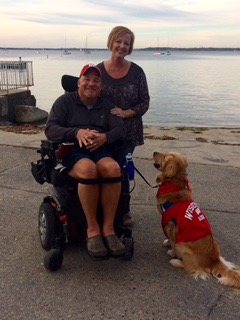
Brian and Marcia Howard visit the lakes of northwestern Wisconsin with Brian’s service dog, Sybil, in the summer of 2015. (Courtesy of Brian Howard)
Eventually, the whisper became the roar of relapsing-remitting multiple sclerosis.
I chose an aggressive treatment path at the University of Minnesota. I wanted to fight. I cycled through medications like Copaxone (glatiramer acetate injection) and Rebif (interferon beta-1a), weathering hospital stays and adverse reactions because I was determined to keep my “normal” life intact. For a decade, I held on to that normalcy with both hands. I maintained a high-travel sales career, and though I eventually traded my football officiating cleats for a stationary bike, I kept moving.
The hardest transition
The most difficult shift wasn’t physical; it was internal. After a few terrifying falls in lonely hotel rooms, my doctor and I made the call: It was time for permanent disability.
Giving up my career felt like losing my identity. I was the provider, the traveler, the “doer.” In the years since, I have tried everything to reclaim my ground — from prayer groups, yoga, and acupuncture, to medical cannabis and strict diets.
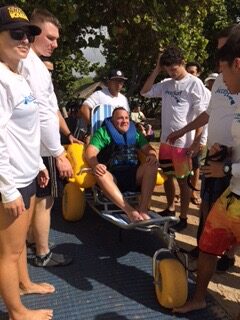
Volunteers prepare to help Brian Howard swim in the ocean in Hawaii in 2016. He also went surfing! (Courtesy of Brian Howard)
But as my condition became progressive, necessitating Ocrevus (ocrelizumab) infusions and the full-time care of my devoted wife, I realized that identity isn’t found in a paycheck or a title. It is found in how you show up for yourself and the people who love you.
Redefining fruitful
If you saw me today, you would see a quadriplegic man in a wheelchair. But if you looked closer, you would see a man who has lived more in the last decade than many do in a lifetime.
Initially, the wheelchair felt like a “one-way trip.” Instead, it became a vehicle for new adventures. Thanks to an incredible circle of friends who raised funds for an accessible van, I didn’t lose my freedom; I simply changed how I exercised it. My life remains vibrant and full with the following.
Travel: With the help of caregiving agencies and accessible accommodations, I have flown across the ocean to visit my daughter in Barcelona, Spain; spent extended time with family in Arizona and Florida; and explored the beauty of northern Minnesota. Traveling with MS can be possible with accommodations from airlines and the Transportation Security Administration, accessible hospitality and vehicle rentals, and caregiving agencies.
Adventure: In Hawaii, I was strapped to a surfboard, feeling the rush of the Pacific — a moment of pure, salt-sprayed joy that reminded me I am still very much alive.
Companionship: Between my faithful service dog and a network of devoted family and friends, I am surrounded by a brand of loving support that no medicine can mimic.
The essential truth
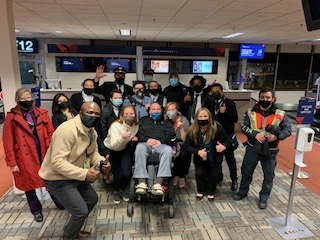
Crew members from Delta Airlines provided disability accommodations for Brian Howard so he could fly to Phoenix in the winter of 2021. (Courtesy of Brian Howard)
MS is a thief, yes. It steals mobility and independence. But it also acts as a filter, stripping away the superficial and leaving behind only what is essential. It has revealed a village of heroes in my life and taught me that a fruitful life isn’t measured by how fast you run, but by how deeply you love and are loved in return.
I am still here. I am still Brian. And we are still looking for the cure.
To submit your own Guest Voice for publication on Multiple Sclerosis News Today, please email your idea to our columns manager at [email protected] with the following included in the subject line: “Guest Voice: Multiple Sclerosis News Today.”
Note: Multiple Sclerosis News Today is strictly a news and information website about the disease. It does not provide medical advice, diagnosis, or treatment. This content is not intended to be a substitute for professional medical advice, diagnosis, or treatment. Always seek the advice of your physician or other qualified health provider with any questions you may have regarding a medical condition. Never disregard professional medical advice or delay in seeking it because of something you have read on this website. The opinions expressed in this column are not those of Multiple Sclerosis News Today or its parent company, Bionews, and are intended to spark discussion about issues pertaining to multiple sclerosis.



Lisa Bowser
Thank you for your article! Stay blessed and continue to be a blessing!
Helen James
So beautifully and honestly written!1 Your writing will be an inspiration to many!! You are blessed! And you have a darling__sweet wife!! Helen James;-)