
New walking station brings gait therapy right into MS patients’ homes
WalkPort device designed to help people with mobility difficulties
Written by |
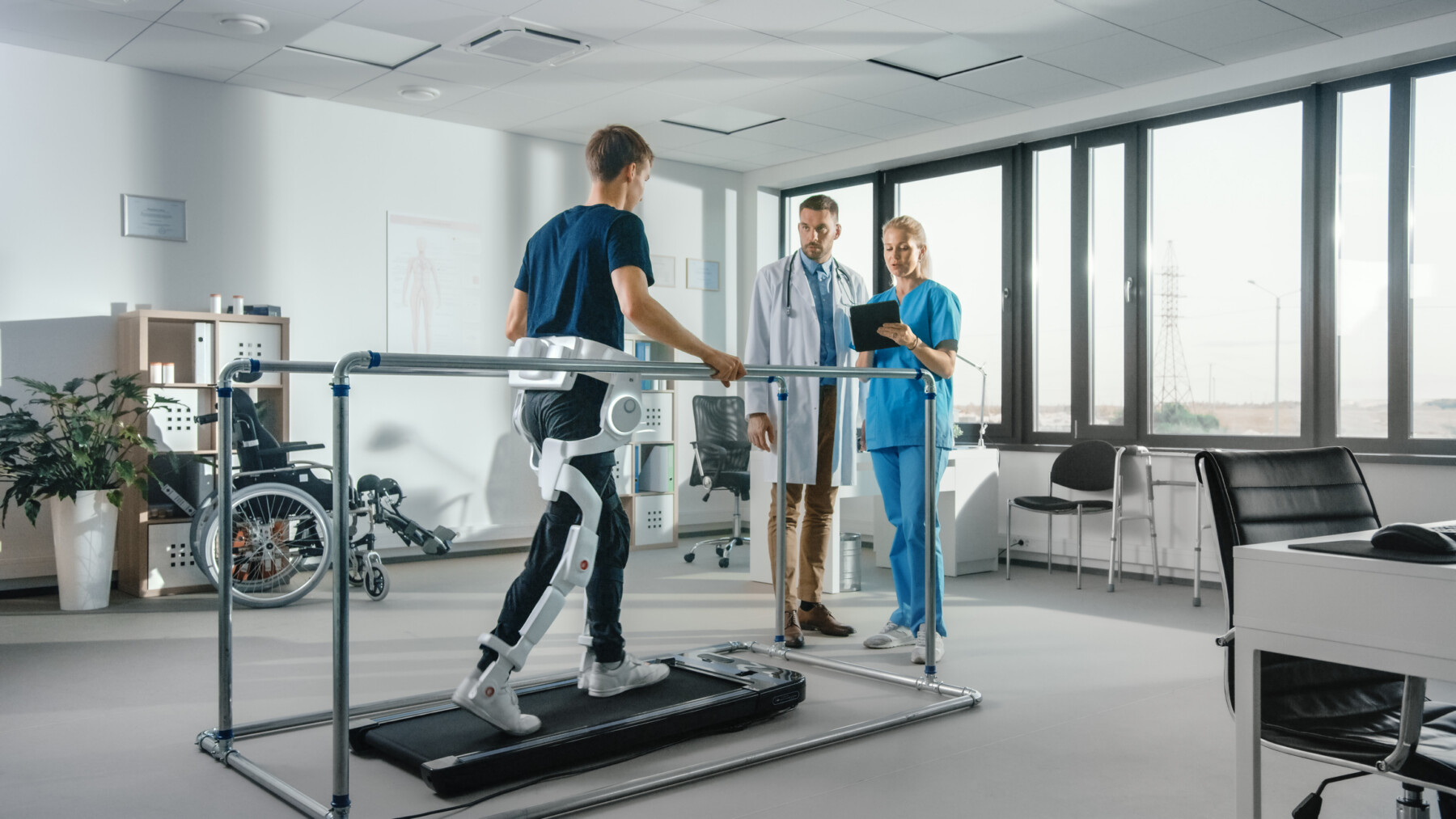
A patient wearing a robotic exoskeleton walks on a treadmill during physical therapy while being monitored by a pair of medical professionals.
- WalkPort, a new device for gait therapy, helps people with mobility difficulties, including those with MS.
- It supports safe standing and walking practice, reducing fall risk for those with mobility issues.
- Used at home or in clinics, it guides walking motions and tracks progress via a mobile app.
Medthera has launched WalkPort, a supported walking station designed to help people with mobility difficulties, including those with multiple sclerosis (MS), safely stand and practice walking at home and in clinical settings.
The device is now open for reservations, with initial shipments expected to start in August, according to the company.
“Walking is more than movement — it’s independence,” Alan Tholkes, Medthera’s founder and CEO, and a longtime quadriplegic wheelchair user, said in a company press release. “I saw firsthand how limited access to consistent therapy slows progress. WalkPort was built to give people a safe way to practice walking every day, whether at home or as part of their therapy program.”

WalkPort can be used at home or in rehabilitation centers
In MS, inflammation of the brain and spinal cord can cause a range of mobility-related symptoms, including muscle stiffness (spasticity), weakness, fatigue, pain, and balance problems.
While physical therapy and regular exercise may help patients maintain mobility and independence, it can be difficult for patients to practice walking outside clinical settings. WalkPort is intended to help address that gap by allowing patients to engage in supported, repetitive walking-like movements.
The equipment, which can be used at home or in rehabilitation centers, helps users with sit-to-stand transitions and includes stabilizing supports to help keep the body upright and stable. This helps reduce the risk of falls and allows users to focus on consistent movement.
To practice walking, the system guides the legs through walking-like motions, which the company says may help reinforce more natural gait patterns.
Before I started using WalkPort daily four weeks ago, it took significant effort to stand up from a chair. Now, I do it almost without thinking.
A companion mobile app then tracks metrics such as steps, pace, and time spent standing or walking, allowing users and therapists to set goals and monitor progress over time. Performance may be accompanied in real time with visual summaries that show walking consistency and efficiency, and how time is spent between standing and walking.
For rehabilitation providers, the device may increase access to walking therapy. Traditional gait training can require multiple therapists to ensure patient safety, but WalkPort is designed to reduce the need for hands-on assistance while maintaining stability.
According to Medthera, the device may also be used in other conditions that affect mobility, including Parkinson’s disease, stroke, and spinal cord injury. It may also be useful for people with age-related mobility limitations.
For Paul, a 54-year-old man who lives with Parkinson’s and has been using the device, his “core strength is much better. Before I started using WalkPort daily four weeks ago, it took significant effort to stand up from a chair. Now, I do it almost without thinking.”




Tristan Brown
I would love to be a patient concerning the new device, machine walkPort. Again my name is Tristan Brown, my phone number 843-804-09 46. My address is 240 Hryne Drive Goose Creek South Carolina 29445.
Tommy B McDonell
Hi. I have MS and am doing PT. Some times I can walk others I can’t. My PT has me walk around the room with a cane and he holds on to me for my balance.
For me an elliptical would be easier than this as I can hold on and am standing. Some have belts also.
Just a thought but this doesn’t strike me as something someone could use by themselves easily.
BUT if I had a treadmill with bars on each side I could do PT more easily than what is above.
Brian Patrick Robson
I was diagnosed a year ago after showing initial gait symptoms during Covid. I’ve been an active athlete most of my life. Walking has become a challenge. I’d love to give this device a try and see how it could improve my mobility challenges and return to a more normal life.
michele colebeck
I HAVE MS AMND HAVE BEEN IN A WHEELCHAIR FOR ABOUT 12-13 YRS. WILL THIS GET ME OUT OF THE CHAIR AND HELP ME WALK IN STORES AROUND THE HOUSE TO DO THINGS, AND DRIVE, HOW MUCH DOES IT COST.
Rob FRosenberg
wanted to know more about it, purchase options etc..
Joan Bondira
This looks like it might be a great piece of technology. I'm sure this would help me quite a lot if it works as well as advertised. I'm also sure that the cost is prohibitive for me and all but a very few, and will health insurance pay for it? Not in the US of A. I don't see most PT clinics investing in these, either. The sad truth is that with healthcare what it is in this country, these kind of innovations are not going to be available to most of the people who need them. Maybe move to Sweden?
Tomáš Trepáč, Ing.
Hi, thank you Very much for New walking station.
Have a nice dače time.
Louis Ziras
Posting misleading AI generated photos is not helpful.
Joyce Aiello
I don't understand I get so frustrated because these devices that are supposed to help you walk or gain Mobility or so expensive you can't even afford them so it's like giving Ms patients false hope cuz a lot of Ms patients can't afford to go to clinics they can't afford the device for at their own home so I just don't get it I don't understand
Jodi Kirtley
How do I get on the list to get to use in my home?