
New owner to offer PoNS device used for walking, balance in MS
With acquisition, Bioness Medical expands its line of rehabilitation tech
Written by |

Bioness Medical has acquired the PoNS system product line, including its noninvasive device for improving mobility in MS. (Photo from iStock)
- Bioness Medical has acquired the PoNS system product line, including its noninvasive device for treating walking and balance issues in MS, in a new deal.
- Approved in the U.S., Canada, and Australia, the device had been developed by Helius Medical Technologies, now Solana.
- Used during rehabilitation therapy sessions, it works by stimulating tongue nerves for improved movement.
The portable neuromodulation stimulator (PoNS), a noninvasive device that’s approved to improve walking and balance in people with multiple sclerosis (MS), has been acquired by Bioness Medical.
The device was originally developed by Helius Medical Technologies, which rebranded to Solana in September of last year as it pivoted away from its neurotechnology business.
Bioness has acquired the full PoNS system product line, expanding its noninvasive neuromodulation therapies for people with walking and balance issues due to neurological diseases. Financial details of the acquisition were not disclosed.
“PoNS technology represents a differentiated approach to neuromodulation that complements our core … platform,” Todd Cushman, CEO of Bioness, said in a company press release announcing the deal.
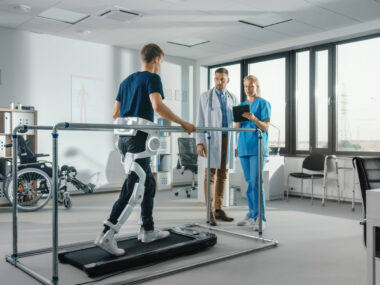
Walking difficulties are among the most common symptoms of MS and are often managed with physical therapy. PoNS is designed to be used alongside a supervised rehabilitation program to boost the benefits of that training.

The device works by delivering mild electrical stimulation to two nerves in the tongue, which are connected to brain regions involved in movement and balance. This stimulation is intended to promote neuroplasticity, a process through which the brain can adapt and form new connections, which may help strengthen the neural circuits that control walking.
PoNS includes a mouthpiece with more than 100 electrodes connected via a cord to a controller worn around the neck. It is placed on the patient’s tongue, and used during supervised therapy sessions focused on improving gait and balance.
PoNS device approved for use in US, Canada, Australia
In the U.S., the device is approved as a short-term treatment for adults, ages 22 and older, with mild to moderate MS symptoms. Similar approvals exist in Australia and in Canada, with PoNS also being cleared in Canada to treat walking issues in people with stroke and traumatic brain injury.
With the acquisition of PoNS, Bioness continues to expand its rehabilitation technology offerings. The company last fall launched a virtual reality rehab platform that added to its existing rehabilitation devices, which primarily use stimulation to activate specific muscles. The new Bioness Integrated Therapy System (BITS) Functional Reality was created to give individuals in rehab an immersive, 360-degree enhanced patient experience.
It adds to systems like the L300 Go, which stimulates nerves in the leg to improve foot movement during walking, and the H200 Wireless that targets muscles in the hand and arm to support daily activities. Another system, Vector Gait & Safety, provides body weight support to help patients safely practice walking during rehabilitation.
Unlike these older approaches, which act directly on muscles or support movement externally, PoNS is designed to stimulate the brain indirectly through the tongue, aiming to retrain the neural pathways that control movement.
“With PoNS, we expand beyond peripheral stimulation into central neuromodulation — offering clinicians a non-invasive therapy that engages neural pathways involved in balance and gait. This positions Bioness to deliver more comprehensive, multi-modal rehabilitation solutions to patients,” Cushman said.


James Pitts
Where can this be accessed in Canada . I live in North Bay Ontario .
ora kofman
How does stimulation of 5, ,7 9 12 10 affect the limbs?
Jasmina Topolnjak
Od Ms-a oboljevaju uglavnom mladi ljudi i super što se im pokušava pomoći ciljano, pogotovo onima koji su nepokretni i ne reagiraju na liječenje sa modernom terapijom.
Robert
Hello how this PONS device be used here in Europe? is there a possibility to purchase it somewhere on the internet?
Thank you in advance.
Christie
Is this covered by Medicare?
Ellyn Sands
How do I get to try Pons? MS for 30 years.
Helen Woodbridge
I have MS and drop foot. My walking is difficult. I am interested in the Bioness PoNS device now available in Australia. Lease send me more info on availability and distributors. I live in the ACT Australia. Thank you Helen 😁
Denise Parkinson
No treatment as too old. Took me offPlegidy and have had relapse. Also Bells Palsy.
Jefery Winesburg
Interest in PoNS cost, and has anyone used it
Philip Marino
PONS only works as long as you have a detour route(hardwired), read the research.
Terry
This looks so exciting. I would love to try it.