
Learning new skills could promote myelin repair in MS patients
Scientists urge more research into strategies for rehab programs
Written by |
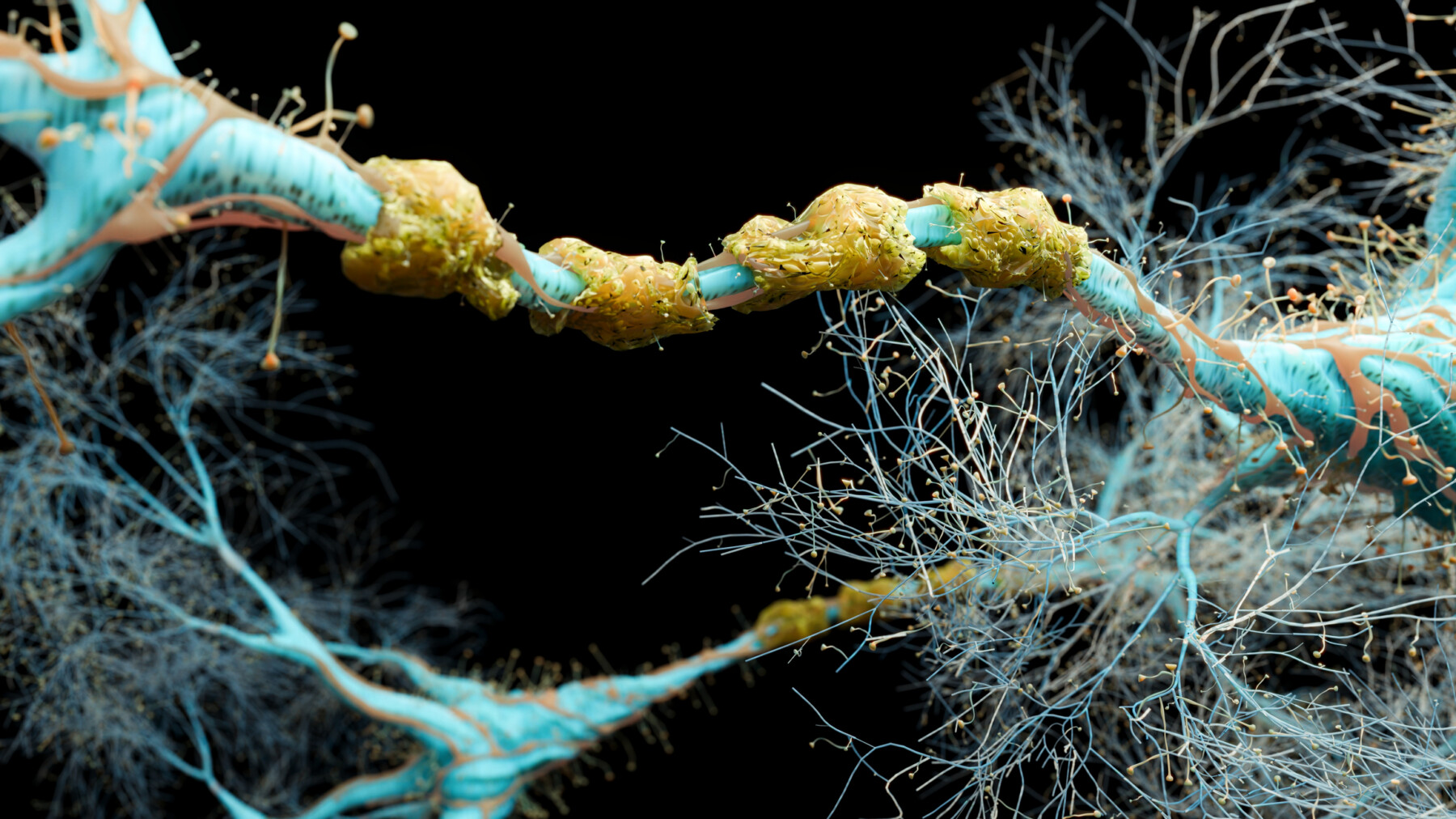
An illustration shows damaged myelin around nerve fibers, similar to the loss of protective insulation that occurs in multiple sclerosis. (Image by iStock)
- Rehabilitation focused on learning new skills may promote myelin repair in multiple sclerosis.
- Myelin damage in multiple sclerosis disrupts nerve signaling, causing symptoms.
- More research is needed to confirm and optimize learning-based rehab for myelin repair.
Rehabilitation strategies aimed at learning new skills may promote myelin repair in people with multiple sclerosis (MS), said scientists, who called for more research to test these strategies and determine the best way to deploy them.
The international team provided an overview of what’s currently known about how rehab might facilitate myelin repair, highlighted unanswered questions, and offered suggestions for future research.
Their paper, “The Potential of Rehabilitation to Amplify Experience-Induced Myelin Plasticity and Remyelination in Multiple Sclerosis: A Narrative Review,” was published in Current Neurology and Neuroscience Reports.
The myelin sheath is a fatty covering that surrounds nerve fibers and helps nerves to send electrical signals, much like rubber insulation around a metal wire. In MS, inflammation in the brain and spinal cord damages the myelin sheath and disrupts nerve signaling, ultimately driving MS symptoms.
A variety of MS treatments can slow disease progression, but they all work by dampening inflammation. No therapy has been definitively proven to promote remyelination (myelin repair) in MS patients. In theory, repairing myelin may not only slow disease progression, but also reverse disease processes, easing symptoms and lessening disability.

Research raises intriguing question
Scientists once believed that healthy brains stop making new myelin in young adulthood. But over the past couple of decades, new research has proven that the brain continues to make new myelin well into adulthood as part of neuroplasticity, the brain’s ability to rewire itself when a person learns something new.
For example, a 2009 study demonstrated that healthy adults who learned to juggle showed an increase in myelin in brain regions that help control hand-eye coordination.
These discoveries have raised an intriguing question: Might it be possible to promote remyelination in people with MS by using rehabilitation programs that help patients learn or relearn new skills, taking advantage of the brain’s natural capacity for rewiring? Such rehab might offer a complementary approach to other interventions, including medications, to promote myelin repair.
There isn’t currently enough data to say with certainty whether learning-focused rehab is a viable strategy to promote myelin repair in people with MS. To date, only 11 studies have directly looked into this question, with conflicting results.
Complicating matters, all these studies have been very small, and each has used different methods for rehab and measuring myelin repair, making it almost impossible to draw meaningful comparisons across studies.
Moreover, many factors may affect myelin repair in people with MS. For example, the brain’s ability to make new myelin tends to decline with age, so rehab strategies may be less effective in older MS patients than in younger people. Other factors, such as biological sex differences, co-occurring health conditions, lifestyle choices, and MS type, may also influence remyelination abilities.
Despite these complexities, the researchers argued that early data are sufficiently promising to warrant further exploration of learning-focused rehab as a potential remyelination strategy.
“Although current findings are promising, they remain fragmented, underpowered, and [variable] in methodology,” they wrote. “Still, a consistent theme emerges: experience-dependent myelin plasticity is both feasible and potentially clinically meaningful, offering a new frontier for neurorehabilitation in MS.”
The team called for further studies with larger sample sizes, longer follow-up times, and more standardized methodologies. They also stressed that it will be key for future research to proactively account for factors such as age.
“Collectively, these research priorities will clarify how experience-dependent myelin plasticity can be harnessed to promote [myelin repair], delay decline, and improve quality of life for people with MS,” the scientists wrote.




Andrew Coburn
I’ve had MS for 30 years and still numb most places but walking well, skiing, biking and hiking.
Would love to remunerate if possible!!
Andy
Tom Kirby
More bollocks Stating something then read a load of tripe that says nothing Saw Jack Kennedy Late fifties Must get a cure for MS Starts in the Brain
Dave McGarry
Buy me helicopter 🚁 instructions and we’ll see if that helps. At least it’s useful.
Roberta Lenski
Please indicate what type of skills were found to be helpful and give more examples. Should the skills be physical or mental? Should I learn a new language or should I learn how to play soccer?
Abigail Kennedy
Want to find the best available treatment for me asap
Ankushree Agarwal
Hi, I would like to know more about Multiple Sclerosis.. WoTs the best treatment I can have?
Heather Bostock
Ive had MS, PPMS, since my 40s, I'm now 74, and am now progressing quite quickly.
I've recently rewired my brain to enable me to walk properly, correcting the quite severe foot-drop and drag in my right leg., because I was fed up with tripping. When I focus I can then walk very well, although dependent on a walker/stroller. If I lose focus my brain then defaults to the old pathway and my right foot drags. It's taken about 6months so far, I'm hoping that my brain forgets the old pathway completely!
I learnt (in 2012!!!) from the Physiotherapy nurses at Wanganui Hospital, New Zealand, that they help patients that have suffered bad strokes. Often they can re-wire, to be able to talk, feed themselves again, write, some of the things we all take for granted until taken away.
Well, if it works for stroke victims, I thought, maybe it would work for me. And it did.
If myelin replacement research is a bit slow how about the Brain Re-Wiring research being encouraged - we already know it works!!