
Experimental compound boosts myelin repair in preclinical MS study
CN045 promoted mature myelin-making cells and modest remyelination in mice
Written by |
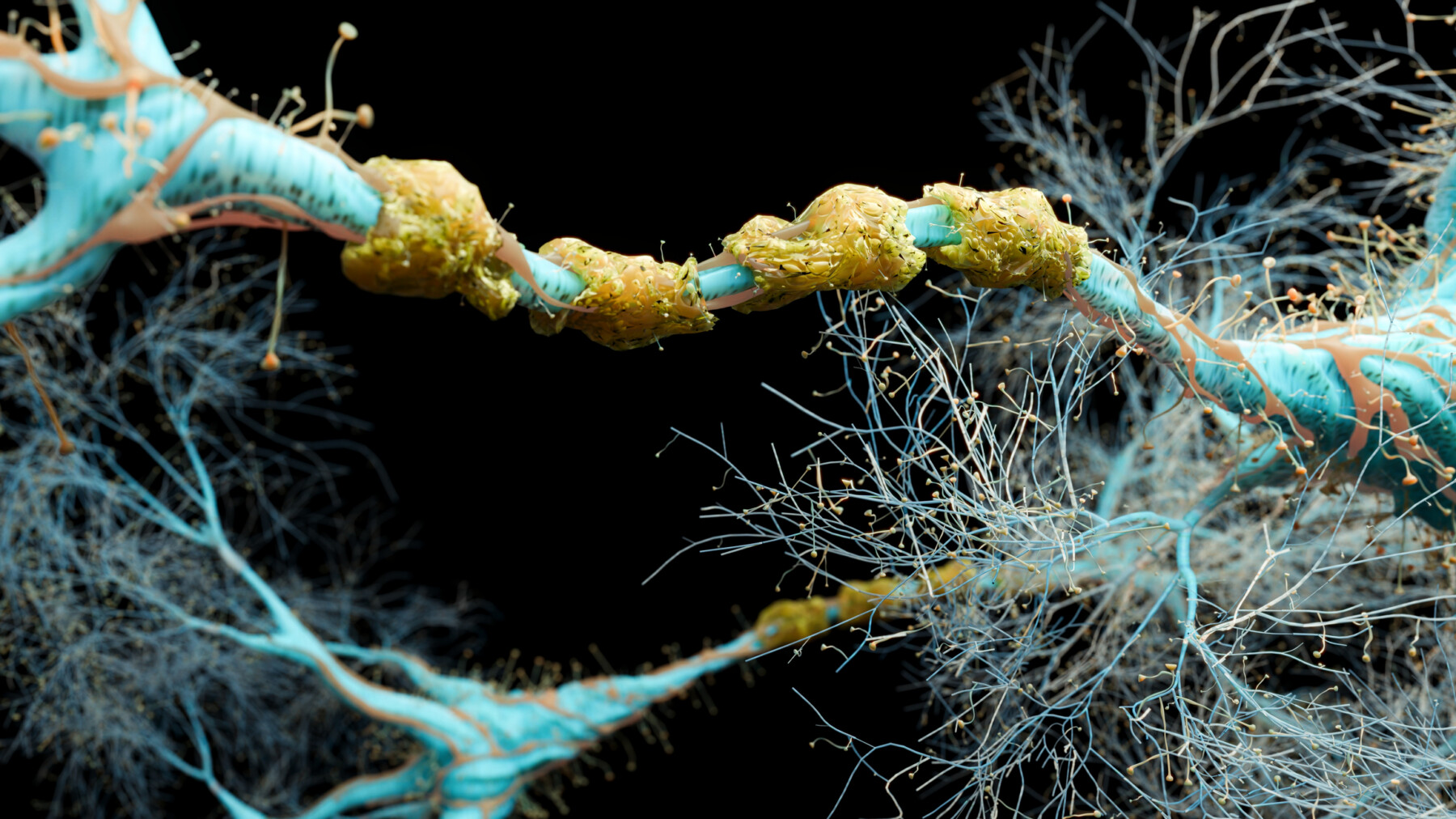
An illustration shows damaged myelin around nerve fibers, similar to the loss of protective insulation that occurs in multiple sclerosis. (Image by iStock)
- A small molecule, CN045, shows promise for repairing myelin damage in multiple sclerosis.
- Preclinical studies indicate CN045 promotes myelin-making cell maturation and remyelination.
- Further research is needed to optimize CN045 and determine whether it could eventually help preserve nerve function in people with MS.
A small molecule called CN045 may help repair myelin — the protective coating around nerve fibers that is damaged in multiple sclerosis (MS) — according to a new preclinical study.
Researchers found that CN045 promoted the maturation of myelin-making cells in lab tests and modestly increased remyelination, the process of repairing damaged myelin, in a mouse model. While much more research is needed to optimize the compound before it could be considered for testing in people, the findings support CN045 as an early lead candidate for developing a remyelination therapy for MS, the researchers said.
The study, “A novel small molecule remyelination therapy for multiple sclerosis,” was published in npj Drug Discovery. The work was supported by the National Institutes of Health, the National Multiple Sclerosis Society, and Ohio Fast Forward.
Why repairing myelin matters in MS
In MS, the immune system mistakenly attacks myelin, the fatty coating that insulates nerve fibers and helps electrical signals travel efficiently through the brain and spinal cord, much like rubber insulation around a copper wire. As myelin is lost, nerve signals are disrupted, contributing to MS symptoms.
More than 20 disease-modifying therapies are approved for MS. These treatments suppress the inflammatory immune activity that damages myelin, reducing relapses and new lesions, but they do not directly repair existing myelin damage. In theory, a therapy capable of restoring myelin might help protect nerve fibers and preserve nerve function.
Within the brain and spinal cord, myelin is produced by cells called oligodendrocytes, which develop from immature oligodendrocyte progenitor cells (OPCs). Encouraging OPCs to mature into myelin-producing cells has long been considered a promising strategy for repairing damaged myelin in MS.
To identify compounds that could do this, a team led by researchers in the U.S. screened 20,000 molecules selected for properties favorable to use in the central nervous system for their ability to promote OPC maturation. CN045 emerged as the lead candidate for further study.
In lab experiments using human OPCs, treatment with CN045 increased the number of mature, myelin-producing oligodendrocytes. The newly formed cells also formed myelin-like coverings around nanofibers designed to mimic nerve fibers, showing that they could carry out a key function of mature oligodendrocytes.
CN045 also promoted modest remyelination in a mouse model of myelin loss, indicating the compound can promote myelin repair in living animals.
CN045 shows promise but needs further optimization
The researchers also found several characteristics that could make CN045 a good drug candidate. The molecule was able to enter the brain, showed low cell toxicity in laboratory and animal testing, and had an intellectual-property path that the researchers said appeared open, potentially easing future development.
One drawback of CN045 is that it is rapidly broken down in the body, reducing how long it remains active. However, the researchers said its chemical structure is well-suited for modifications aimed at improving its stability and other drug-like properties, although further study is needed.
Overall, the team said CN045 represents a promising starting point to develop future remyelination therapies.
“CN045 is brain-penetrable with low [cell toxicity] … and appears to be an attractive contender that can be improved by further lead optimization to generate a clinical candidate for enhancing remyelination in MS patients,” the team concluded.



Jon Rutter
Please keep us posted
Thomas
My girlfriend has R&r Ms....I saw this supplement on Tv n bought it for her....
She had 16 brain lesions when we started trying Sero-Vital amino tabs each day for over a year...NXT check at Dr.s showed only 4 remaining legions!! Y'all need to look into this product for Ms patients! It really transformed her life quality, lowered Ms attacks, n healed the brain also!
This allowed her to operate almost daily n get out of the house to ride her bike all over town, n she loved its results!!
100% true story!!
I'm not a sales person, just saying, Fyi
Thomas
I don't know the science behind why it works, I only know that it does help a ton!
Contact if y'all want
Billy Corbin
Will it help with trigeminal neuralinal.
ET
We need to repair damaged myelin, that is the potential cure that is needed along with ridding the body of Epstein barr virus. Research believes that as long as the virus is in the body it causes the immune system to stay over avtivated as it searches for the virus.
Mark Collins
Sounds really good,but still a long long time out
Tracey Holland
B.c goverment doesnt care about people with M.S
Vicki Baldwin-Veit
How can we follow this research so that we know if it should become available at any time in the near future with any luck?
Mukund Kulkarni
We keep reading such Funds which will help remylination
Do not have any hope something will come out which will truly help all sufferers ..
Rob Thompson
Could n045 then be a treatment do TNG
Ekram
When could CN045 be used by people ?
My mother has been suffering from MS for 23 years and nowadays has a delayed reactions so a remyelination cure is recommended as soon as possible
Paulette Holland
Is there a study being done for human subjects that I might be able to be a participant?
Stephen H Siler
I’ve been diagnosed with CIDP and am now being treated with IvIg Gamunex-C. Now I’m looking for a treatment for remyelenating my frayed nerves. What to do? Help!!
Christina Adragna
I read that once the damage is done regardless of remyelation , you can never get back to normal. If that’s false, that would be wonderful, but I read that the damage is permanent.
Bishnu Kafle
My son has suffered from MS since 10 years. I am from Nepal. I want to know MS treatment & supportive therapy…
Janet Liston
Medical Cannabis
Neena Vyas
I have been reading your news letters for the last 10 years to keep up with news of research in MS