
Study points to new target for protecting myelin in multiple sclerosis
Loss of Piezo2 led to motor problems and abnormal myelin in mice
Written by |
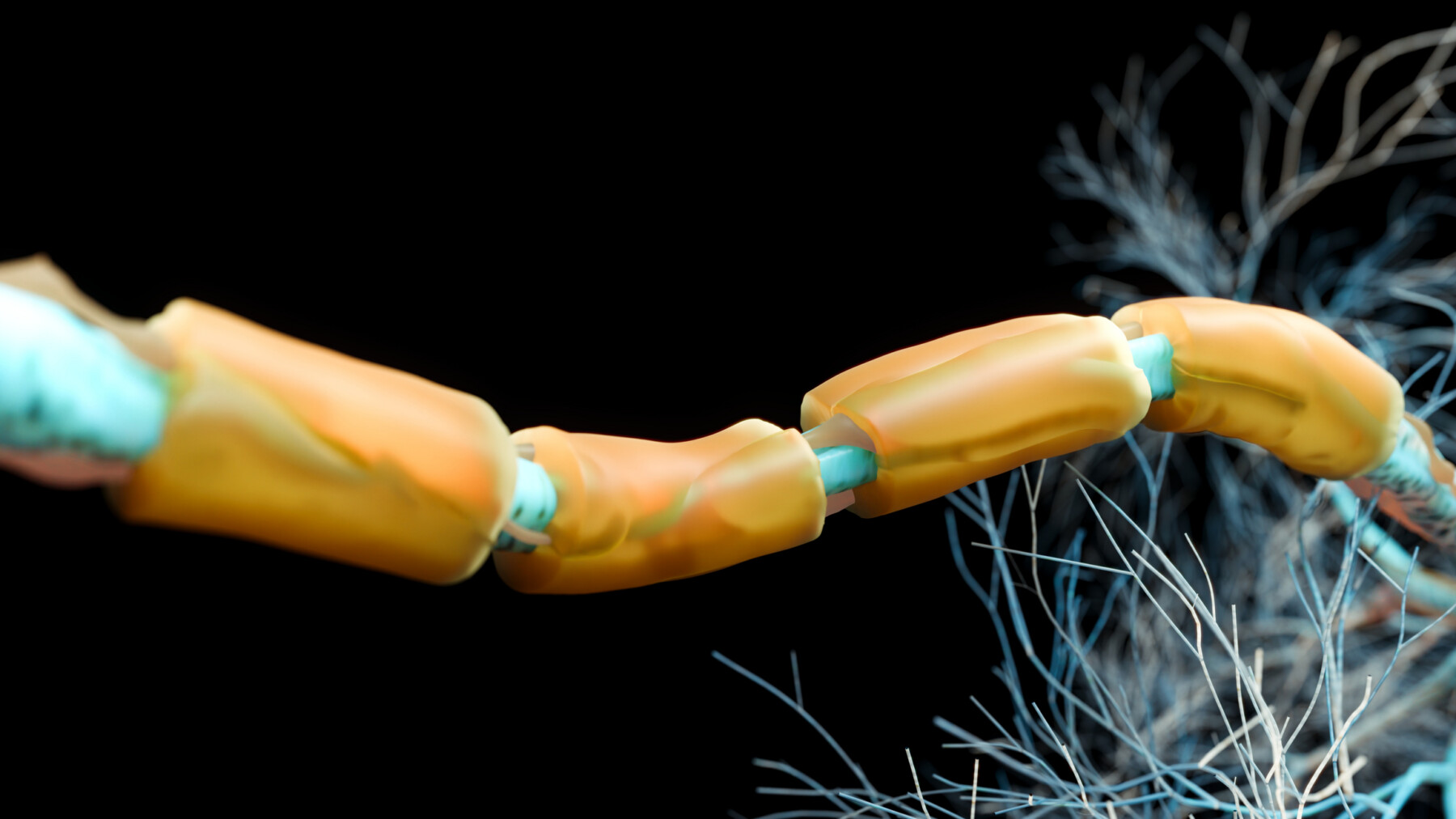
A nerve fiber is wrapped in myelin, the protective coating damaged in multiple sclerosis. (Photo from iStock)
- Loss of Piezo2 in myelin-producing cells caused motor problems and abnormal myelin in mice.
- Piezo2 expression was also reduced in oligodendrocytes in optic nerve tissue from people with MS.
- Piezo2 signaling may offer a treatment target for preserving myelin, but more research is needed.
A protein called Piezo2 may help maintain the myelin sheath around nerve fibers, or axons, and could offer a new therapeutic target for preserving myelin in multiple sclerosis (MS), according to a preclinical study.
Mice lacking Piezo2 in oligodendrocytes, the cells that make myelin, developed age-related motor problems and abnormal myelin wrapping around small nerve fibers in the optic nerve, which relays signals between the eyes and the brain. Piezo2 expression was also reduced in oligodendrocytes in optic nerve tissue from deceased people with MS, including in white matter near lesion edges.
“These data identify Piezo2 as an age-related regulator of [oligodendrocyte] function and myelin integrity, with potential relevance for preserving white matter structure in multiple sclerosis,” the researchers wrote. White matter is brain and spinal cord tissue composed mainly of axons covered by myelin.

Piezo2 may help maintain myelin integrity
The study, “Oligodendrocyte Piezo2 is a regulator of age-dependent myelin integrity and dysregulated in multiple sclerosis,” was published in Communications Biology.
In MS, the immune system launches inflammatory attacks against the myelin sheath, the fatty insulating layer that wraps around axons in the brain and spinal cord and helps electrical signals travel efficiently. Damage to myelin and the underlying axons contributes to progressive nerve-cell degeneration and loss of function.
Researchers are studying therapies designed to promote remyelination — the repair or replacement of damaged myelin — in hopes of protecting nerve fibers and possibly restoring some lost function. However, no remyelination therapy is currently approved for MS.
Piezo2 is part of a family of channel proteins that allow cells to sense mechanical forces, such as pressure or stretching. It’s mostly been studied in the peripheral nervous system, the network of nerves outside the brain and spinal cord that helps relay sensations such as touch, body position, and pain.
However, Piezo2’s role inside the brain and spinal cord, particularly in myelin-producing oligodendrocytes, is not well understood.
A team led by researchers in Germany investigated whether Piezo2 helps maintain myelin and whether changes involving the protein may be relevant to MS. They focused on the optic nerve because it is commonly affected by demyelination, or myelin loss, and inflammation in MS.
Mouse studies reveal effects of Piezo2 loss
The researchers first examined gene activity in cells from the optic nerve of healthy mice. Experiments revealed that Piezo2 was mainly present in mature, late-stage oligodendrocytes that help maintain existing myelin, “indicating a role in myelin integrity rather than formation,” the team wrote.
Piezo2 expression was also found in fibroblasts, a type of supportive cell, located near the outer membranes of the optic nerve, and in a subset of retinal ganglion cells, the neurons that send visual signals through the optic nerve.
Mice engineered to lack Piezo2 specifically in oligodendrocytes had lower body weight compared with unaltered mice and developed motor problems as they aged. The effects were detected earlier, and were more pronounced, in female mice.
When examining the physical structure of myelin in the optic nerve and spinal cord, the team found that myelin layers in Piezo2-deficient mice were loosely wrapped rather than tightly packed. This problem was particularly evident around small-caliber axons in the optic nerve. These thin nerve fibers are known to be especially vulnerable to demyelination in MS.
Axon size and density were comparable between mice with and without Piezo2 in oligodendrocytes, indicating that the myelin itself, not the nerve fibers, was affected. The researchers also observed a higher density of mitochondria, the cell’s energy-producing structures, in optic nerve axons of Piezo2-deficient mice, which may reflect increased energy demands.
Gene activity analysis in oligodendrocytes lacking Piezo2 showed reduced activity of the Lama2 gene, which is involved in myelination and myelin integrity, and increased activity of Pde3a, a gene involved in signaling within cells.



Anne Karanja
I have been having problem walking for a very long time, I was recently told that my nerves on the lower back are demyolinated, is there a hope for returning to normal?