Tascenso ODT (fingolimod) for multiple sclerosis
 Fact-checked by
 What is Tascenso ODT for MS?
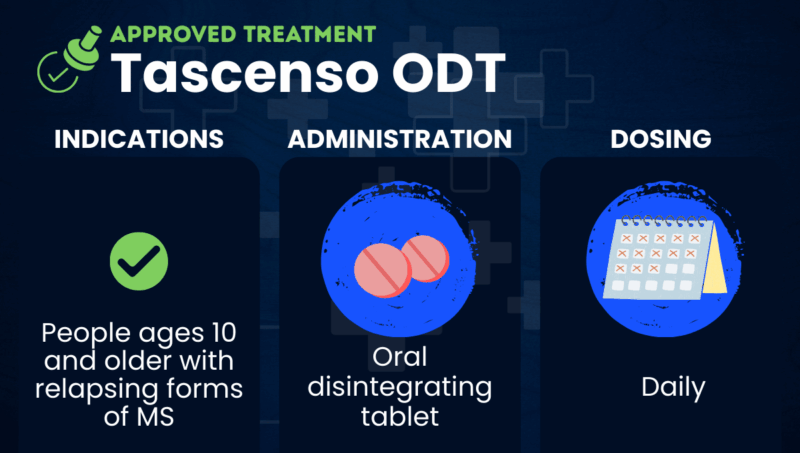
Tascenso ODT (fingolimod) is an oral disease-modifying therapy approved for people ages 10 and older with relapsing forms of multiple sclerosis (MS), including clinically isolated syndrome (CIS), relapsing-remitting MS (RRMS), and active secondary progressive MS (SPMS).
Tascenso ODT, taken once daily as an oral disintegrating tablet, is used to reduce the risk of disease relapses, prevent the development of new brain lesions, and potentially slow disability progression.
In MS, the immune system mistakenly attacks nerve cells in the spinal cord and brain. Immune cells called lymphocytes play key roles in these attacks.
Tascenso ODT works to trap lymphocytes within lymph nodes — immune organs where some immune cells are matured and stored — preventing them from reaching the nervous system and causing damage. It does this by modulating the activity of the sphingosine 1-phosphate receptor, a protein that helps regulate cell movement into and out of lymph nodes.
The therapy is marketed in the U.S. by Cycle Pharmaceuticals as an alternative to Gilenya, an older approved MS therapy. The two medications are bioequivalent, meaning they deliver the same active ingredient (fingolimod) to the body in the same amount and at the same rate, and are thus expected to have a highly similar safety and efficacy profile.
Tascenso ODT is not, however, a generic form of Gilenya, as it uses a different delivery method. Gilenya comes in oral capsules that are swallowed whole, while Tascenso ODT tablets dissolve on the tongue.
Therapy Snapshot
| Brand name | Tascenso ODT |
| Chemical name | Fingolimod |
| Usage | Used to reduce disease activity and potentially delay disability progression in relapsing forms of MS |
| Administration | Oral disintegrating tablet |
Who can take Tascenso ODT?
Tascenso ODT is approved in the U.S. for adults and children ages 10 and older with CIS, RRMS, or active SPMS.
The medication is contraindicated for people who:
- have experienced certain cardiovascular events in the past six months, including heart attacks, chest pain (unstable angina), stroke, mini-stroke, or some types of heart failure
- have an irregular heart rhythm (arrhythmia) or heart block, including prolonged QT, a finding sometimes seen on heart exams
- have experienced serious immune reactions (hypersensitivity), including allergic reactions, to fingolimod or other ingredients in the medication
- are using other medications containing fingolimod, including Gilenya or its generics
How is Tascenso ODT administered?
Tascenso ODT is available as oral disintegrating tablets that dissolve within seconds when placed directly on the tongue. The tablets can be taken with or without water and with or without food.
The tablets are taken once daily at a recommended dose of 0.5 mg for adults and children weighing more than 40 kg (approximately 88 lbs), and 0.25 mg for children weighing 40 kg or less.
Initiating Tascenso ODT can cause an abnormally slow heartbeat. Patients will need to be monitored for this complication at the first dose and when restarting treatment after a pause of more than 2 weeks.
Tascenso ODT in clinical trials
After it was established that Tascenso ODT was bioequivalent to Gilenya and thus would be expected to have a similar safety and efficacy profile, the U.S. approval of Tascenso ODT was supported largely by three Phase 3 clinical trials of Gilenya:
- FREEDOMS (NCT00289978) tested Gilenya against a placebo in more than 1,200 adults with RRMS over two years. Participants who received the currently approved 0.5 mg dose of Gilenya had a 54% lower risk of relapse and a 30% lower risk of disability progression than those in the placebo group. Gilenya also reduced the number of active, new, or enlarging brain lesions and brain volume loss on MRI scans.
- TRANSFORMS (NCT00340834) compared Gilenya to the injectable MS therapy Avonex (interferon beta-1a) in more than 1,200 adults with RRMS over about one year. Compared with the Avonex group, participants who received Gilenya (0.5 mg) had about a 50% lower relapse rate, lower MRI disease activity, and had slower brain volume loss. A long-term extension period suggested the medication remained effective for up to 4.5 years.
- PARADIGMS (NCT01892722) compared Gilenya to Avonex in 215 children with RRMS, ages 10 to 17, over two years. The Gilenya dose (0.5 or 0.25 mg) was determined by weight as on the prescribing label. The results demonstrated a significant 82% decrease in relapse rate with Gilenya compared with Avonex. Gilenya was also associated with fewer active, new, or enlarging brain lesions and slower disability progression.
Tascenso ODT side effects
The most common side effects associated with Tascenso ODT include:
- headache
- elevated levels of liver enzymes, indicating potential liver damage
- diarrhea
- cough
- flu-like symptoms
- sinus inflammation
- pain in the back, abdomen, or extremities
Tascenso also carries a risk of less common, but potentially serious side effects. These include:
- slow heart rate or arrhythmias
- serious infections, including progressive multifocal leukoencephalopathy, a potentially fatal brain infection
- swelling in parts of the eye, which can cause vision loss
- liver injury or damage, which could lead to liver failure
- swelling and narrowing of blood vessels in the brain, which can lead to stroke if untreated
- breathing problems
- tumefactive MS, a rare form of MS that causes symptoms similar to those of a brain tumor
- increased blood pressure
- cancer, including skin cancer or lymphoma
- hypersensitivity reactions
Patients using Tascenso ODT will be carefully monitored for these adverse effects, which may require adjustments to the treatment regimen. There is a risk that stopping treatment with Tascenso ODT can trigger a severe increase in disease activity, so close monitoring is also necessary after treatment discontinuation.
Tascenso ODT may cause fetal harm if used during pregnancy. Women of childbearing potential should use effective contraception during treatment and for two months after stopping Tascenso ODT.
Multiple Sclerosis News Today is strictly a news and information website about the disease. It does not provide medical advice, diagnosis, or treatment. This content is not intended to be a substitute for professional medical advice, diagnosis, or treatment. Always seek the advice of your physician or other qualified health provider with any questions you may have regarding a medical condition. Never disregard professional medical advice or delay in seeking it because of something you have read on this website.