
My grandma reminded me that I am more than the sum of my MS symptoms
The non-MS parts of me deserve attention, too
Written by |

I vividly remember swimming in my grandparents’ pool when I was 5 or 6 during a family gathering. My older cousins started comparing their features and deciding which relatives they most resembled. Naturally, I started scanning around for my match, too. I am adopted, however, and I do not look like my blond-haired, blue-eyed mother, or really anyone else in my family.
My grandma noticed me searching and, without missing a beat, took me by the hand and led me into the bathroom. Standing together in front of the mirror, she pointed out our dark hair, green eyes, and whatever other similarities she could find. I walked back outside proudly announcing that I looked like my grandma.
The resemblance may have been somewhat generous physically, but over the years, I became like her in ways that mattered far more. My grandmother Sasha became my role model. Our brains worked similarly, and we shared a need for creative expression and a deep appreciation for music and art. She hand-painted china, crafted miniatures, and played the piano. We had art dates and exchanged CDs of music we thought the other would love.

My disease is not all of me
When I was diagnosed with relapsing-remitting multiple sclerosis (MS) at 16, my grandma understood the struggle in a way many people could not. She lived with rheumatoid arthritis and fibromyalgia. She understood what it was like to have a body that required more from you than it should, while still recognizing the person underneath it.
As rheumatoid arthritis increasingly affected her hands, the tiny, detailed work she loved became more difficult. But her creative life actually expanded. She moved into acrylic painting, watercolors, and decoupage. She joined a book club, learned Spanish for fun, and even joined a dance group that performed an awesome Halloween mob dance. My grandma had a superpower for adapting to difficult circumstances without disappearing inside them.
Living with MS can require so much attention that nearly everything in my life becomes about taking care of my body: monitoring symptoms, managing medications, attending appointments, researching options, and trying to make decisions that best preserve my health and physical function.
It is all necessary. But my grandma helped me recognize that taking care of the medical and physical aspects of illness is not always the same as taking care of me.
When life becomes particularly heavy, my focus narrows to whatever feels most urgent: the next symptom, appointment, or problem requiring a solution. During those times, even when I was working incredibly hard to stay afloat, she’d remind me when I had stopped making room for the parts of myself that had nothing to do with being a patient.
The parts that still needed care
I initially did not respond well to those nudges. The idea that I should paint, write, or listen to music while already exhausted sounded like another thing I was failing to do. I didn’t think she understood how much energy it took simply to manage what was already happening. But she did understand.
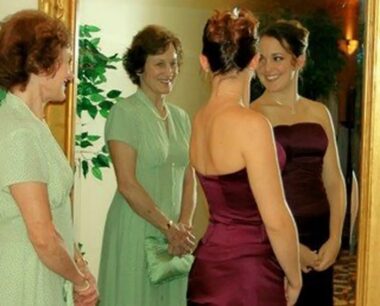
Ahna Crum, right, and her grandmother Sasha gaze into a mirror at the other’s reflection. (Courtesy of Ahna Crum)
She was not telling me to find a hobby, adopt a more positive attitude, or distract myself from MS. She was reminding me that the parts of myself I had spent a lifetime developing still needed care, too.
That can be easy to forget during times when caring for my body uses nearly everything I have. The things that make my life feel like mine stop feeling urgent next to a flare, relapse, or medical decision.
My grandma had a different way of viewing her body. Doctors could examine it, poke and prod it, and document its struggles, and she knew it deserved care, but it was not the full measure of who she was.
I try now to remember that distinction.
MS affects my body, but caring for that body is not the entirety of caring for me. I still need words, art, music, and opportunities to express emotions that cannot be addressed during a neurology appointment.
Those things do not improve a lesion, reverse a symptom, or produce a measurable result on an MRI. They may even look unproductive beside everything else demanding my limited energy. But they remind me that my life is not just something to manage, but to enjoy.
I do not always have the capacity to return to the activities I love in the same way. Sometimes writing is only a paragraph. Sometimes art is messy and unfinished. My grandma taught me that adapting an outlet does not make it less meaningful.
She died last November, and I miss her more than I know how to explain. I treasure the way she helped me see myself. When I was a little girl, she stood beside me in a mirror and made sure I could recognize where I belonged. As an adult, she reminded me that illness could change my body and consume my attention without becoming the whole of who I am.
Tending to my health helps preserve my life. Tending to the parts of myself that illness cannot define helps me stay alive inside of it.
Note: Multiple Sclerosis News Today is strictly a news and information website about the disease. It does not provide medical advice, diagnosis, or treatment. This content is not intended to be a substitute for professional medical advice, diagnosis, or treatment. Always seek the advice of your physician or other qualified health provider with any questions you may have regarding a medical condition. Never disregard professional medical advice or delay in seeking it because of something you have read on this website. The opinions expressed in this column are not those of Multiple Sclerosis News Today or its parent company, Bionews, and are intended to spark discussion about issues pertaining to multiple sclerosis.


Lisa Bowser
Thank you for the beautiful article.
Have a blessed day and continue being a blessing through your writing!
Megan Yost
As someone else who's adopted and has MS, your article makes a lot of sense to me.
I've been very close to one of my aunts who told me recently the same thing. She then told me that I'm her hero for dealing with my MS the best way I can. That meant the world to me. I had the same feeling after reading your article.