
How to manage MS treatment plateaus
Last updated September 17, 2025 by Agata Boxe
 Fact-checked by Inês Martins, PhD
When you are managing multiple sclerosis (MS), you may encounter treatment plateaus, where symptoms no longer seem to improve. These pauses in noticeable progress can be frustrating, especially if you’ve been working hard to manage your condition. But they’re also a common part of living with MS.
Understanding why plateaus happen and learning strategies to navigate them can help you feel more in control and better equipped to support your health.
Understanding MS treatment plateaus
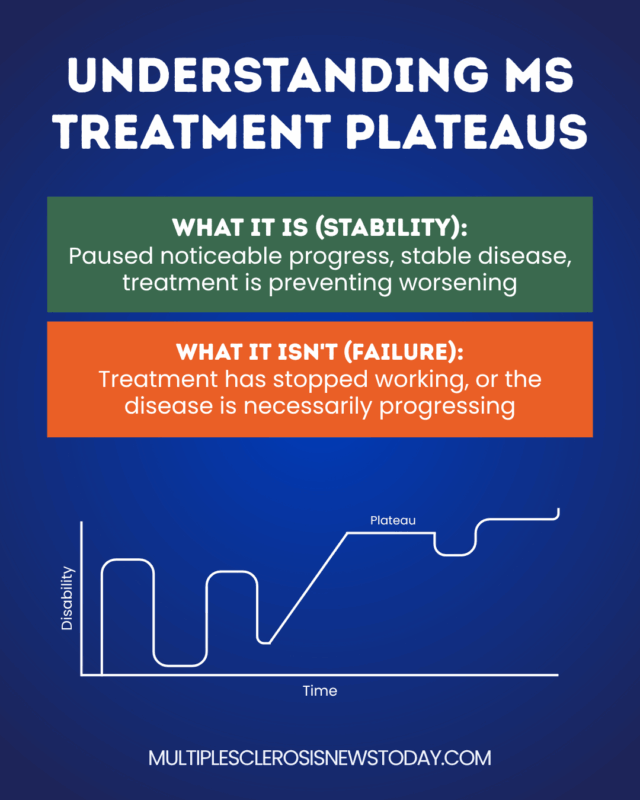
If you experience a plateau, it doesn’t necessarily mean that your MS treatment has stopped working or that your disease is progressing. In many cases, it means your condition has not changed or that further improvements aren’t noticeable right now.
Plateaus can occur after your symptoms have improved following a relapse or after your disease has been well controlled for a period of time. The absence of new changes may actually be a sign that your treatment is continuing to prevent your condition from worsening.
Reassessing your treatment plan
If you’re concerned about how you feel or how well your MS medication is working, it’s always best to talk to your neurologist.
They may choose to run tests, such as an MRI scan, to check for new disease activity and decide whether a change in medication is needed.
Changing to a different MS medication often isn’t necessary if your symptoms aren’t worsening. Your neurologist may recommend other modifications, such as physical therapy or occupational therapy. Or they may prescribe additional medications to address specific symptoms, such as pain, fatigue, or mobility issues.
Considering lifestyle adjustments
Your lifestyle plays an important role in preventing MS progression, and it can complement the effects of MS medications.
If you are feeling disheartened due to a plateau, consider making small adjustments to your daily habits to nurture your well-being.
Examples include:
- going to sleep and getting up at the same time every day to improve sleep quality
- exercising under the guidance of a physical therapist
- using assistive devices such as canes or walkers and voice-activated systems
- eating a healthy diet in consultation with a registered dietician
- trying to manage stress by practicing mindfulness meditation
- conserving energy throughout the day to ease fatigue
Communicating with your care team
If you have doubts about the effectiveness of your current treatment plan, you may not want to wait until your next visit to raise concerns about it. You have the right to consult your doctor whenever you need to.
Try to track your symptoms by writing them down and bringing your notes to an appointment. The more information you can provide, the more prepared your provider can be to help you.
Be honest about how you feel when you talk to your doctor and don’t hesitate to ask questions.
Final thoughts
Although MS treatment plateaus can feel discouraging, they are often an expected phase of the disease course. They may be a sign of stability, which is the foundation for long-term progress.
Through careful symptom tracking, open communication with your care team, and adjusting your lifestyle, you can stay proactive in managing MS and supporting your overall health.
Multiple Sclerosis News Today is strictly a news and information website about the disease. It does not provide medical advice, diagnosis, or treatment. This content is not intended to be a substitute for professional medical advice, diagnosis, or treatment. Always seek the advice of your physician or other qualified health provider with any questions you may have regarding a medical condition. Never disregard professional medical advice or delay in seeking it because of something you have read on this website.