Masitinib for multiple sclerosis
 Fact-checked by
 What is masitinib for MS?
Masitinib is an investigational oral therapy being developed by AB Science for the treatment of progressive forms of multiple sclerosis (MS), including primary progressive MS (PPMS) and nonactive secondary progressive MS (SPMS).
Taken daily as oral tablets, masitinib has been found in a clinical trial to slow disease progression in these patient groups.
In MS, the immune system mistakenly attacks myelin — the protective coating around nerve fibers — causing ongoing inflammatory damage that leads to neurodegeneration.
Chronic neuroinflammation and neurodegeneration in progressive MS is thought to be driven in part by immune cells called mast cells and microglia. Activated mast cells release inflammatory molecules and weaken the protective barrier around the brain, while microglia are brain-resident cells that become pro-inflammatory when abnormally activated.
Masitinib, previously known as AB1010, works to block the activity of enzymes called tyrosine kinases that are involved in the activation and growth of these cells. In doing so, masitinib reduces the number of these immune cells in the brain, which is expected to reduce inflammation and slow the progression of MS.
AB Science is also testing masitinib for other neurodegenerative diseases, blood disorders, and mast cell-mediated conditions.
Therapy snapshot
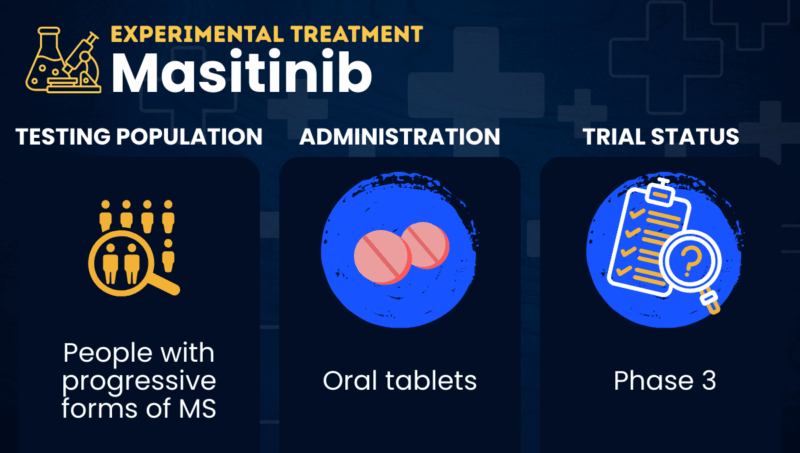
| Treatment name: | Masitinib |
| Administration: | Oral tablets |
| Clinical testing: | Completed two trials for PPMS and nonactive SPMS; a Phase 3 trial is ongoing |
How will masitinib be administered?
Masitinib is available in the form of film-coated oral tablets, which are taken twice daily. An ongoing Phase 3 clinical trial is testing it at a daily dose of 4.5 mg/kg, but it is too soon to know for sure which dose and regimen will be used if the drug is ultimately approved.
Masitinib in MS clinical trials
Masitinib has been tested in two completed clinical trials involving a total of 646 adults with PPMS or nonactive SPMS.
- A proof-of-concept Phase 2a clinical trial, called AB04011 (NCT01450488), enrolled 35 adults who were randomly assigned to receive masitinib — at a dose of 3 or 6 mg/kg per day — or a placebo for at least one year. While the results failed to reach statistical significance, the masitinib group showed a 103% increase in the MS Functional Composite (MSFC) scale — a composite measure of walking ability, dexterity, and cognitive function — while those on a placebo showed a 60% reduction. Also, a greater proportion of masitinib-treated patients were considered MSFC responders than those receiving a placebo (32% vs. 0%).
- A larger Phase 2b/3 clinical trial, called AB07002 (NCT01433497), then enrolled 611 adults who were randomly assigned to masitinib — at a dose of 4.5 or 6 mg/kg per day — or a placebo, given twice daily for about two years. The trial met its main goal, with masitinib’s low dose outperforming a placebo at slowing disability progression, as measured by score changes on the Expanded Disability Status Scale (EDSS). Patients on this dose had a 42% lower risk of first disability progression and a 37% lower risk of three-month confirmed disability progression. Also, none reached a level of disability severe enough to require a wheelchair, while 4% of those given a placebo did.
Building on results from these two studies, AB Science launched a Phase 3 clinical trial, called MAXIMS (NCT05441488), which is currently testing twice-daily masitinib against a placebo in around 800 adults with PPMS or nonactive SPMS.
Participants on masitinib are receiving a 4.5 mg/kg dose following a four-week titration period on a lower dose of 3 mg/kg. The main goal is to determine whether masitinib can delay the time to three-month confirmed disability progression over about two years. The trial is expected to finish in 2028.
Masitinib side effects
Masitinib is still being tested in clinical trials for MS, so its safety profile is not fully established. So far, the most common side effects reported during clinical trials included:
- diarrhea
- rash
- nausea or vomiting
- swelling in the legs, arms, feet, and hands
- itching
- changes in blood tests, including low blood cell counts, decreased phosphorus, elevated sodium, and low hemoglobin, a red blood cell protein
Multiple Sclerosis News Today is strictly a news and information website about the disease. It does not provide medical advice, diagnosis, or treatment. This content is not intended to be a substitute for professional medical advice, diagnosis, or treatment. Always seek the advice of your physician or other qualified health provider with any questions you may have regarding a medical condition. Never disregard professional medical advice or delay in seeking it because of something you have read on this website.