Types of multiple sclerosis
 Fact-checked by
 There are four main types of multiple sclerosis (MS), a neurological disorder that affects the brain and spinal cord. These MS types are defined by how symptoms begin and how the disease progresses over time.
MS occurs when the immune system mistakenly attacks myelin, the protective coating around nerve fibers. When myelin is damaged or lost, a process called demyelination, nerve cells have trouble sending signals properly. This can lead to a wide range of symptoms, depending on which parts of the nervous system are affected.
Understanding the different types of MS can help explain how the disease may change over time and which MS treatment options, including disease-modifying therapies (DMTs), may be most appropriate.
What are the four types of MS?
Experts generally recognize four main types of MS:
- clinically isolated syndrome
- relapsing-remitting MS
- secondary progressive MS
- primary progressive MS
These MS types are used to guide diagnosis and treatment decisions. However, growing evidence suggests they may not be completely distinct conditions, but rather different stages of a single, continuous disease process.
There are also other rare forms of MS and MS-like disease.
Clinically isolated syndrome
Clinically isolated syndrome (CIS) refers to a first episode of neurological symptoms that suggest MS. To be considered CIS, symptoms must:
- last at least 24 hours
- be caused by inflammation and demyelination in the central nervous system (CNS), which includes the brain, spinal cord, and optic nerves
- occur in the absence of fever or infection
Symptoms may result from damage in one or more areas of the CNS. These areas of damage are often visible as lesions on an MRI scan.
Although CIS is a first episode of MS-like symptoms, it does not automatically meet the criteria for an MS diagnosis. Under the McDonald criteria — guidelines used to diagnose MS — a person with CIS can only be diagnosed with MS if MRI scans, laboratory tests, or clinical findings show additional evidence of the disease.
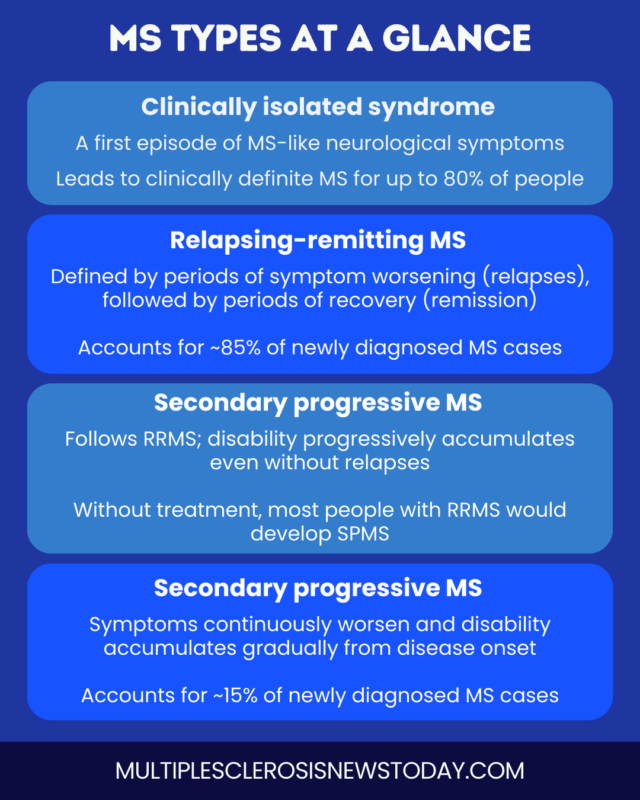
Not everyone with CIS goes on to develop MS. The presence of brain lesions on MRI scans is a strong predictor of progression. People without detectable lesions have about a 20% chance of developing clinically definite MS, while the risk rises to about 60%–90% with brain lesions.
People considered at high risk of progression may be treated with DMTs to delay or prevent the onset of clinically definite MS.
Relapsing-remitting MS
Relapsing-remitting MS (RRMS) is the most common form of the disease, accounting for about 85% of newly diagnosed cases. RRMS is marked by relapses, periods when new symptoms appear or existing ones worsen, followed by periods of remission, when symptoms ease or stabilize.
RRMS can also be described as:
- active or nonactive, based on whether a person experiences relapses and/or shows new brain lesions on MRI scans
- worsening or not worsening, based on whether disability increases following a relapse
Biologically, RRMS is thought to be driven mainly by bursts of active inflammation that damage the myelin coating and nerve fibers in the brain and spinal cord. This differs from progressive forms of MS, which tend to involve slower, ongoing immune activity that contributes to steady nerve cell damage over time.
Secondary progressive MS
Secondary progressive MS (SPMS) develops in many people who were initially diagnosed with RRMS. In this stage, symptoms of MS gradually worsen over time, even as relapses become less frequent or stop altogether.
Some people with SPMS still experience relapses, but these episodes are often less distinct than in RRMS, and symptoms usually do not fully resolve during remission.
SPMS can also be classified as:
- active or nonactive, based on MRI evidence of new damage or relapses
- with or without progression, depending on whether disability continues to increase over time
Before MS treatments were widely available, about half of people with RRMS transitioned to SPMS within 10 years, and up to 90% within 25 years. With modern treatments, fewer people develop SPMS, and the transition generally occurs later. Newer estimates suggest that when most patients receive appropriate DMTs, only about 10% transition to SPMS over a median of more than 30 years.
The biological processes that drive the transition from RRMS to SPMS are still not fully understood.
Primary progressive MS
Primary progressive MS (PPMS) is diagnosed in about 15% of people with MS. Like SPMS, it involves a gradual worsening of symptoms without clear relapses and remission. However, in PPMS, this steady increase in disability begins from the onset of the disease.
PPMS can be classified as:
- active or nonactive, based on MRI evidence of new damage and/or occasional relapses
- with or without progression, depending on whether disability continues to accumulate
Compared with relapsing forms of MS, people with PPMS typically have fewer brain lesions but more lesions in the spinal cord. Symptoms also tend to begin about a decade later than in people with relapsing MS types.
Overall, PPMS is generally more difficult to diagnose and treat than relapsing forms of MS.
Identifying MS type
MS classification relies on a combination of clinical symptoms, MRI findings, and laboratory tests. When a person experiences MS-like symptoms for the first time, they may initially be diagnosed with CIS. If additional evidence is present, a diagnosis of clinically definite MS may be made right away.
RRMS
RRMS may be diagnosed in someone with CIS if there is clear evidence that nerve damage has occurred in multiple parts of the CNS and:
- damage occurred at different points in time, or
- laboratory tests show characteristic signs of CNS inflammation
In some cases, having lesions in enough areas of the CNS may be sufficient to support an MS diagnosis.
SPMS
There is no single test that defines the transition from RRMS to SPMS. Diagnosis is usually made by reviewing disease progression over several months. Signs of SPMS may include:
- continuous disability progression, even without relapses
- fewer active, inflammatory lesions in the brain or spinal cord
PPMS
To diagnose PPMS under the McDonald criteria, a person must meet the general criteria for MS. There are also two distinctions specific to PPMS, including:
- at least one year of continuous disease progression without remission
- evidence of spinal cord involvement, such as two or more spinal cord lesions, which can substitute for widespread CNS damage
Is MS treatment the same for each type?
Most available DMTs work by reducing inflammation. For this reason, they are most effective in relapsing forms of MS — including CIS, RRMS, and active SPMS — where inflammation plays a larger role.
More than 20 DMTs are approved in the U.S. for relapsing forms of MS. Most are also approved in other countries, though some may be indicated only for RRMS.
Far fewer treatments are available for people with progressive MS. In the U.S., Ocrevus (ocrelizumab) and Ocrevus Zunovo (ocrelizumab and hyaluronidase-ocsq) are the only approved therapies for PPMS. Mitoxantrone is approved for nonactive SPMS but is rarely used due to serious safety concerns.
| Type | Frequency | Clinical presentation | Approved DMTs |
|---|---|---|---|
| Clinically isolated syndrome | About 3-4 of every 100,000 people are diagnosed with CIS per year; about 80% will develop true MS. | A first episode of MS-like neurological symptoms lasting at least 24 hours. | Aubagio, Avonex, Bafiertam, Betaseron, Briumvi, Copaxone, Extavia, Gilenya, Kesimpta, Mayzent, Ocrevus, Ocrevus Zunovo, Plegridy, Ponvory, Rebif, Tascenso ODT, Tecfidera, Tysabri, Vumerity, Zeposia |
| Relapsing-remitting MS | Accounts for approximately 85% of newly diagnosed MS patients. | Characterized by relapses, when new symptoms appear or existing ones worsen, and periods of remission. | Aubagio, Avonex, Bafiertam, Betaseron, Briumvi, Copaxone, Extavia, Gilenya, Kesimpta, Lemtrada, Mavenclad, Mayzent, mitoxantrone, Ocrevus, Ocrevus Zunovo, Plegridy, Ponvory, Rebif, Tascenso ODT, Tecfidera, Tysabri, Vumerity, Zeposia |
| Secondary progressive MS | Untreated, most people with RRMS will eventually transition to SPMS. | Continual worsening of symptoms over time, even in the absence of relapses. | Active SPMS: Aubagio, Avonex, Bafiertam, Betaseron, Briumvi, Copaxone, Extavia, Gilenya, Kesimpta, Lemtrada, Mavenclad, Mayzent, mitoxantrone, Ocrevus, Ocrevus Zunovo, Plegridy, Ponvory, Rebif, Tascenso ODT, Tecfidera, Tysabri, Vumerity, Zeposia Nonactive SPMS: mitoxantrone |
| Primary progressive MS | Accounts for roughly 15% of newly diagnosed MS patients. | Gradual worsening of symptoms from disease onset. | Ocrevus and Ocrevus Zunovo |
Rare forms of MS
Other terms are sometimes used to describe rare patterns of multiple sclerosis or MS-like disease. These include:
Malignant MS
Malignant MS is a very aggressive form of the disease in which disability builds up much faster than usual. People with this form of MS often experience severe relapses and may require a walking aid within about five years of disease onset. Other names that may be used for this form of MS include fulminant, Marburg, aggressive, or advanced MS.
Inactive MS
Inactive MS, sometimes called benign MS, refers to a form of RRMS in which a person has few symptoms and little disability for many years, often 15 years or longer. However, disease activity can change over time, and symptoms may worsen later on. In some cases, inactive disease is described as “burned-out” MS, a term used when disease progression appears to slow dramatically after a long period of worsening.
Pediatric-onset MS
Although MS most often develops in adults, it can also affect children and adolescents younger than 18. In these cases, it is referred to as pediatric MS or pediatric-onset MS (POMS). Children with POMS almost always have RRMS. Compared with adults, they tend to experience more frequent relapses, but they often recover faster and more completely from those relapses.
Radiologically isolated syndrome
In some cases, a person may have evidence of lesions on MRI scans similar to those seen in MS but will not have overt symptoms of the disease. This is known as radiologically isolated syndrome (RIS).
Earlier versions of the McDonald criteria required people to have MS-like symptoms before diagnosis. However, some people with RIS may now be diagnosed with MS if additional evidence of disease activity is found on MRI scans or laboratory tests.
Multiple Sclerosis News Today is strictly a news and information website about the disease. It does not provide medical advice, diagnosis, or treatment. This content is not intended to be a substitute for professional medical advice, diagnosis, or treatment. Always seek the advice of your physician or other qualified health provider with any questions you may have regarding a medical condition. Never disregard professional medical advice or delay in seeking it because of something you have read on this website.