
MS patients can level up cognitive skills with virtual reality rehab
Using new technology helps sharpen memory, processing, review finds
Written by |

Using virtual reality tech in rehabilitation programs for people with MS can lead to cognitive gains, a new review found. (Image from iStock)
- Virtual reality rehabilitation programs help improve cognitive skills in people with multiple sclerosis, a study found.
- Specifically, VR-based therapy enhanced processing speed, memory, and executive function in MS patients.
- The review found MS patients stuck with VR-based rehab, with adherence over 80%.
A rehabilitation program using virtual reality (VR) may help improve some cognitive skills — especially those related to processing speed and memory — in people with multiple sclerosis (MS), according to a new review covering more than a dozen studies.
The researchers found that incorporating this type of new technology into rehab programs for MS patients led to significant gains, particularly in handling day-to-day tasks and in visuospatial memory, or the ability to recall information about an object’s appearance and its physical location. Importantly, according to the team, most participants stuck with these VR-based rehab programs, with more than three-quarters completing them.
Overall, “VR-based rehabilitation appears to be a safe, feasible, and effective approach for enhancing cognitive abilities in individuals with MS,” the researchers wrote.
The review study, “Effectiveness of Immersive and Non-Immersive Virtual Reality Interventions on Cognitive Function in People with Multiple Sclerosis: A Systematic Review,” was published in the Journal of Clinical Medicine.

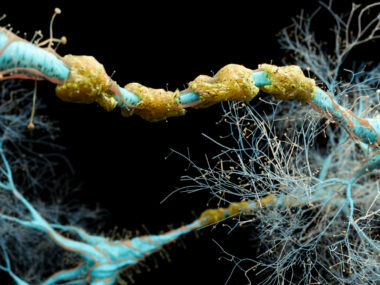
In MS, a mistargeted immune response attacks myelin, the protective coating that surrounds nerve fibers, disrupting communication between the brain, spinal cord, and the rest of the body.
Cognitive problems can result, and, in fact, are estimated to affect as many as 70% of people with Parkinson’s. For many, they are considered among the disease’s most disabling symptoms. These commonly affect attention, memory, processing speed, and executive function, or the mental skills needed for planning, organization, and multitasking.
Absent specific medications, rehab deemed key to cognition
To date, no medications have been approved specifically for MS-related cognitive problems, making rehabilitation and other nondrug approaches an important part of care.
VR-based rehab uses computer-generated environments that a person can interact with while performing skill-strengthening activities. Such programs often are immersive, using head-mounted displays, or semi-immersive, using large screens or projection systems. However, they can also be nonimmersive, using only standard screens and game-like platforms. Regardless, all use technology to a greater degree than non-VR-based techniques.
“VR offers structured, motivating, and ecologically valid environments for cognitive training,” the researchers wrote, adding that these approaches may support rehabilitation by increasing engagement, providing multisensory feedback, and simulating real-world tasks.
Studies in MS patients have shown that VR therapy may improve rehabilitation adherence, limb function, and cognitive functioning.
“However, existing reviews often combine [variable] study designs, [and] lack clear differentiation between immersive and non-immersive VR,” the researchers wrote.
Now, to get a bigger picture of the research done to date, a team in Chile systematically reviewed studies published through October 2025. Each reported data from an appropriately-controlled trial assessing cognitive outcomes after VR-based rehabilitation in adults with MS.
A total of 13 studies comprising 649 participants met the inclusion criteria and were used in the final analysis. The number of patients involved in each trial varied widely, ranging from 17 to 124. Altogether, the patients had a mean age of approximately 40.
“Hospital-based programs integrating VR with conventional occupational or physical therapy were the most frequent, while home-based and telerehabilitation approaches using exergaming platforms such as Kinect or Nintendo Switch were also explored,” the researchers wrote.
Most VR interventions were semi-immersive and nonimmersive, but two studies tested treadmill-integrated immersive VR protocols. Interventions varied widely in terms of duration, frequency, and intensity. Most programs lasted between six and eight weeks, typically involving 1-5 sessions per week lasting 30 to 60 minutes.
Because of the variability of the VR programs, the researchers were unable to conduct a meta-analysis, which is a statistical review that pools data across studies. Instead, the team summarized the findings descriptively.

Adherance to virtual reality rehab topped 80%
Overall, the most consistent benefits of VR-based rehabilitation were seen in the participants’ speed in processing information, their ability to handle complex, multistage tasks, and their memory skills — relating to both language and what they were seeing around them.
The researchers noted strong gains in visuospatial memory, or the ability to remember shapes, colors, and faces, as well as the physical locations of objects and their movements in relation to one another in the surrounding environment.
According to the team, “most studies demonstrated significant improvements in processing speed, visuospatial and verbal memory, and executive functioning.”
Several studies focused on gains in processing speed, while others reported improvements in verbal learning and memory, visuospatial memory, attention, and/or cognitive flexibility. Cognitive flexibility refers to the ability to seamlessly switch between tasks, concepts, or mental perspectives.
The team also noted a reduction in cognitive-motor interference, which occurs when the simultaneous performance of cognitive and motor tasks causes a decline in performance on one or both.
Across the included studies, VR-based rehabilitation appeared feasible and generally well tolerated, the researchers noted, adding that completion rates were high.
“Adherence rates were above 80%, and no serious adverse events were reported,” the team wrote.
Overall, [virtual reality] emerges as a safe, feasible, and promising complement to traditional rehabilitation, offering an innovative pathway toward more engaging, individualized cognitive therapy for people with MS.
According to the researchers, simple VR applications may be suitable for some home-based programs, especially when paired with caregiver support and periodic remote monitoring. VR programs could be personalized based on disease stage, disability level, cognitive needs, and available resources, the team noted.
However, the scientists stressed that VR should be viewed not as a replacement for standard rehabilitation. Instead, it should be seen as a complementary tool within a broader multidisciplinary care plan.
Indeed, its benefits may be greater when incorporated into programs involving occupational therapists, physiotherapists, and neuropsychologists, the researchers noted.
The findings altogether suggest that VR interventions may result in meaningful cognitive benefits in people with MS, the team concluded.
“Overall, VR emerges as a safe, feasible, and promising complement to traditional rehabilitation, offering an innovative pathway toward more engaging, individualized cognitive therapy for people with MS,” the researcher wrote.
Still, however, “evidence remains inconclusive due to variability in sample size, intervention design, and assessment methods,” the team noted. “Future research should prioritize standardization of protocols and outcome measures to consolidate the evidence base and facilitate the integration of VR into cognitive rehabilitation for people with MS.”



Roberta Lenski
Great article, but how do I obtain this therapy? Please include information on how and or where to find the therapy.
Helen Moore Powell
Too bad no one will give you whatever it takes to get one. And it absolutely doesn't work. We need Stem Cell Therapy approval period.
Dorothy J Lyon-Lee
I am very interested in the VR therapy. I love the results of doing the physical exercises, but anything that make it more appealing, is good!